How to get a police clearance certificate in Kenya within 24 hours
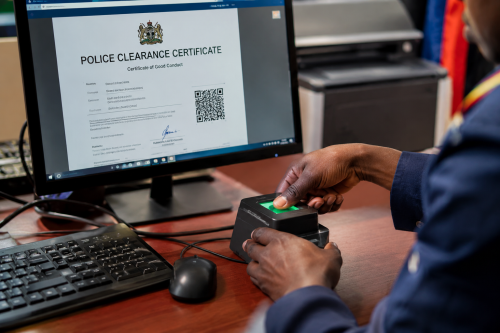
By Aloys Michael, July 23, 2026Kenyans applying for a Police Clearance Certificate, commonly known as a Certificate of Good Conduct, will soon receive the document within 24 hours instead of waiting up to two weeks, following the rollout of a new biometric identification system designed to speed up identity verification and criminal investigations.
On Thursday, July 23, 2026, Interior Cabinet Secretary Kipchumba Murkomen announced the changes during the launch of the Multi-Biometric Identification System (MBIS–ABIS Version 5) and the handover of the ANSI National Accreditation Board (ANAB) certificate to the Directorate of Criminal Investigations’ (DCI) Forensic Evidence Management Unit (FEMU).
“The turnaround time for processing police clearance certificates, which previously took up to 14 days or more, will now be reduced to just 24 hours,” Murkomen said.
The faster processing is expected to benefit thousands of Kenyans applying for jobs, government positions, visas, higher education opportunities and overseas employment, where a Police Clearance Certificate is often required.

The application
The government’s new biometric platform will significantly reduce the time it takes to process Police Clearance Certificates by improving fingerprint verification.
According to Murkomen, the upgraded system expands Kenya’s fingerprint database from two million to 10 million records while increasing daily fingerprint search capacity from 4,500 to 20,000. This allows investigators to verify identities more quickly and support faster criminal investigations.
The announcement does not change who qualifies for a Police Clearance Certificate. Eligible applicants will continue applying under the existing requirements set by the Directorate of Criminal Investigations.
The certificate is commonly required by job seekers, public service applicants, students, visa applicants and Kenyans seeking employment abroad.
When will the 24-hour processing begin?
Murkomen said the shorter turnaround will be achieved through the rollout of the new biometric system, although the Interior Ministry has not announced when the service will become available nationwide.
“We will also be rolling out biometric enrolment to police stations nationwide so investigations can move faster and services reach people closer to home,” he said.
Does the application process change?
No. The Interior Ministry has not announced any changes to the application process, required documents or official fees. Applicants should continue using the existing Police Clearance Certificate application process until the Directorate of Criminal Investigations issues updated operational guidelines.
The government has also not clarified whether applications already being processed will benefit from the new 24-hour timeline. Murkomen said the government plans to integrate the biometric platform with the National Registration Bureau, the Judiciary, the Immigration Department and INTERPOL through legislative and policy reforms.
The integration is expected to support real-time identity verification, intelligence sharing and cross-border crime detection.
Why the new system
Beyond reducing waiting times for Police Clearance Certificates, the government says the new technology will modernise policing and strengthen criminal investigations.
Murkomen said Kenya’s internationally accredited Forensic Evidence Management Unit now meets globally recognised standards for handling forensic evidence.
“This accreditation means our chain of custody for evidence now meets international standards. Evidence will be collected, stored and presented properly, which means stronger prosecutions and more convictions from our courts,” he said.
He added that the reforms will strengthen Kenya’s investigative capabilities.
“It positions Kenya as a regional leader in forensic science and sends a strong message to criminals: our investigative capabilities are stronger and our justice system is increasingly equipped to hold offenders accountable,” Murkomen said.
For now, Kenyans seeking a Police Clearance Certificate should continue following the current application process. The main change will be a faster turnaround once the upgraded biometric system is fully implemented and the Directorate of Criminal Investigations (DCI) announces its nationwide rollout.