Advertisement
How political slogans change peoples’ perceptions in polls
Wednesday 24th August, 2022 02:27 AM|
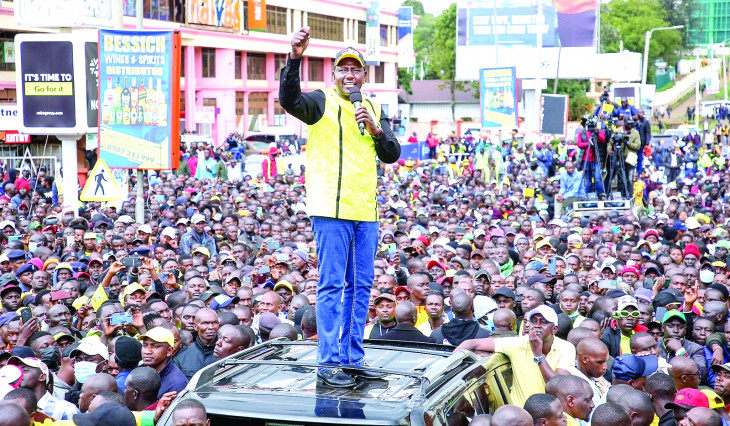
Sloganeering has dominated politics across the world for hundreds of years and it has greatly contributed to election conquests, or lack of them, in many parts of the world. A campaign slogan is a short, memorable phrase used in politics and advertising.
Usually, a campaign slogan is a purified version of a campaign theme that makes a clear distinction between politicians and their opponents. A walk down memory lane shows political slogans have been around for centuries. In the US, political slogans can be traced to as far back as the 1800s, specifically to the 1840 election campaign for President William Henry Harrison.
Slogans are used as a short idea and can be for or against any particular political issue. They are an ingenious way to advertise and promote political ideas. In most cases, it is a memorable one-line statement.
In the first US presidential election since the end of World War II, incumbent Harry S Truman, a Democrat, was broadly expected to lose. While campaigning on a whistle stop tour of the nation, a supporter shouted “Give em’ hell, Harry!” at the candidate, and the phrase was embraced as the slogan of the dull former general’s supporters. He went on to thrash Republican Thomas E Dewey.
Persuading voters is the core of a political campaign. Glittering advertising, melodic theme songs, charismatic speeches, and even negative campaigning have been around for ages, and each advance in technology has offered new opportunities for candidates to influence voters.
In an article published in QuartzAfrica in August 2017, author Abdi Latif Dahir revealed that elections in Kenya then were a race between the incumbent president Uhuru Kenyatta and opposition leader Raila Odinga, who was making his fourth bid at the presidency. Uhuru was running on the slogan of ‘tano tena’. The opposition, energised by the administration’s alleged failings, was calling for voters to remove Uhuru from power on ‘nane nane’ (August 8, the date of the election).
It is scientifically proven when people are faced with a tough decision, they tend to lean towards the most popular opinion. In politics, parties will focus on creating slogans about their political ideologies or policies to sway voters. A perfect example in the just concluded election is ‘Bottom Up’ and ‘Inawezekana’ slogans by the main formations.
A campaign slogan should not be created out of thin air. A major blunder made by many campaigns is the development of a political slogan without thinking about the campaign’s general messaging. A typical mistake when building slogans is to confuse the campaign message with the campaign slogan. At first glance, the two ideas might seem to be extremely similar, but each has a distinct place in a political campaign strategy.
According to Mark Zucker, who wrote in the Forbes magazine, the theme of Franklin D Roosevelt’s first campaign slogan ‘Happy Days’ is a classic example of their effectiveness. It was actually a song written in 1929 by Milton Ager and Jack Yellen, and which was coined during The Great Depression.
More important than a slogan’s inherent appeal is the way it enters into definite contexts of situation, draws from previous contexts and resounds with a candidate’s larger campaign theme. Obama’s ‘Yes, we can’ slogan demonstrates all these elements.
A 2019 study Not with Her: How Gendered Political Slogans Affect Conservative Women’s Perceptions of Female Leaders, used ‘I’m with Her’ slogan to examine the response of conservative US women toward Democratic nominee Hillary Clinton during the 2016 US presidential election. It established that it resulted in increased ratings of perceived hostility and less support for her.
Kenyan women politicians also displayed their mettle in the campaigns during the just concluded elections with slogans such as ‘Mama Miradi’, Mama Sanitiser’, ‘GavananiMama and ‘Kaba Maathe’. This serves as testament to the power of slogans in driving political agenda and speaking directly to the electorate. A good slogan is a key to a successful political campaign. It is used as an effective branding technique or to establish the party’s values and goals for voters.
— The writer is Certified Public Relations practitioner
Author
PD columnist
View all posts by PD columnistLatest News








Advertisement
More on Insights