Advertisement
Beyond the smart board: Can Kenya’s digital classroom revolution deliver real learning gains?
Thursday 11th June, 2026 09:48 AM|
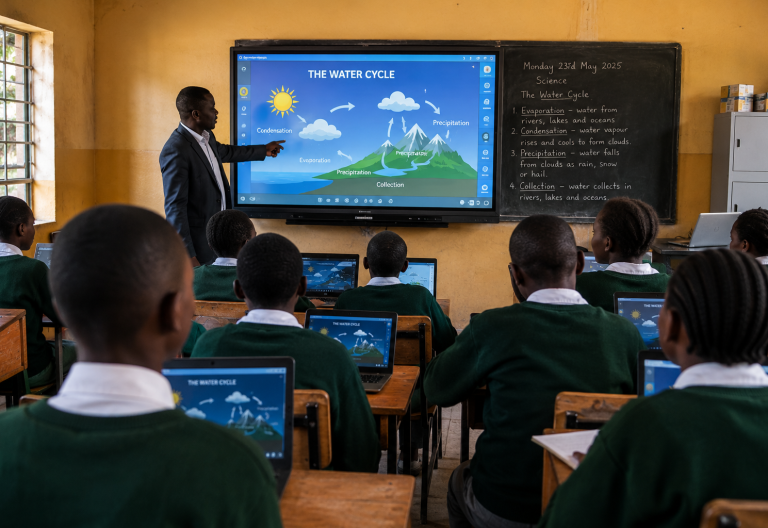
For nearly two decades, Kenya has pursued the dream of a digitally empowered classroom. From the early promises of laptop programmes to the rollout of the Competency-Based Education (CBE) curriculum, technology has repeatedly been presented as the key to transforming learning and preparing young people for a rapidly changing world.
That vision took another significant step forward as the government flagged off the distribution of laptops and interactive smart boards to 10,382 Junior Secondary Schools across the country. While the delivery of digital devices marks a major milestone, education experts say the real test lies not in the number of gadgets distributed but in whether they can fundamentally improve learning outcomes.
The initiative, implemented through the Kenya Digital Economy Acceleration Project (KDEAP) with support from the World Bank, will provide each targeted school with a teacher laptop and a 65-inch interactive smart board.
Government officials describe the programme as an investment in the country’s future workforce and digital competitiveness.
You Might Also Like



“Today, we are not merely flagging off devices; we are investing in human capital, digital skills and the future prosperity of our children. We want our learners not to merely consume technology, but to create it, innovate through it, and apply it to solving challenges facing their communities and our nation,” said Principal Secretary for Broadcasting and Telecommunications Stephen Isaboke.
The statement reflects a broader shift in education policy. Increasingly, governments worldwide are moving beyond traditional literacy and numeracy to focus on digital competencies, problem-solving abilities and innovation skills that are expected to drive future economies. For Kenya, the stakes are particularly high.
As artificial intelligence, automation and digital services reshape labour markets, schools are under growing pressure to equip learners with skills that extend beyond textbooks. Digital learning tools are viewed as critical in helping students develop technological fluency from an early age.
Yet technology alone does not guarantee better education. Past experiences across Africa have shown that many digital learning projects struggled because devices arrived before the supporting ecosystem was ready. Challenges ranging from unreliable electricity and poor internet connectivity to inadequate teacher training often limited their impact.
Recognising these risks, government officials insist the current rollout is part of a broader strategy rather than a stand-alone technology project.
“The true value of this programme will not be measured by the number of devices delivered, but by the impact they create in classrooms. We envision teachers delivering more interactive lessons, learners accessing richer educational content, and schools becoming centres of innovation and digital excellence,” ICT Authority Chief Executive Officer Jessy Maruti said.
His remarks highlight a growing recognition that educational transformation depends as much on how technology is used as on the technology itself.

Bridging Kenya’s digital divide
The government’s emphasis on connectivity is particularly significant. While digital devices can support learning, their effectiveness is often constrained when schools lack reliable internet access.
Officials say progress is being made. More than 30,000 kilometres of fibre optic infrastructure have already been deployed nationwide toward a target of 100,000 kilometres, while more than 8,000 public institutions have been connected to the internet.
The challenge now is ensuring that rural and underserved schools benefit equally from these investments.
World Bank officials argue that the devices could help narrow long-standing educational inequalities by giving learners access to richer and more engaging content regardless of their location.
“These devices will make lessons more visual, interactive and engaging, supporting digital literacy from an early stage and helping young Kenyans develop the skills increasingly required in today’s labour market,” said KDEAP Task Leader Aneliya Muller.
Her comments point to a wider economic argument underpinning the initiative. Digital literacy is increasingly becoming a prerequisite for participation in modern economies, and countries that fail to equip young people with these skills risk widening future employment and income gaps.
For policymakers, the rollout is therefore about more than education it is also about national competitiveness.
“Today’s flag-off marks a significant milestone in Kenya’s digital transformation journey. By integrating technology into our classrooms, we are equipping learners with the skills needed to thrive in the Fourth Industrial Revolution and reinforcing Kenya’s position as a leader in ICT and the digital economy,” said Dagoretti South MP John Kiarie, Chairperson of the National Assembly Committee on Communication, Information and Innovation.
As thousands of devices begin their journey to schools across Kenya, the success of the programme will ultimately be judged not by procurement figures or distribution statistics, but by what happens inside classrooms.
If teachers are empowered, connectivity expanded and learners actively engaged, the smart boards could become powerful tools for educational transformation. If not, they risk becoming expensive symbols of unrealised potential.
The coming years will reveal whether Kenya’s latest digital learning investment can bridge the gap between technology access and meaningful learning or whether the country’s digital classroom revolution still has lessons to learn.
Author
Latest News








Advertisement
More on Insights