Willis Otieno: State acting as broker in Kenya Pipeline sale to benefit Ruto
By Kenneth Mwenda, October 2, 2025Lawyer Willis Otieno has sharply criticised the government’s plan to privatise the Kenya Pipeline Company (KPC), warning that the process is designed to enrich President William Ruto at the expense of Kenyans.
In a statement posted on X on Thursday, October 2, 2025, Otieno said the sale is not genuine privatisation but self-dealing. He argued that the state has reduced itself to a broker, transferring public assets to private hands.
“What is unfolding is not privatisation but self-dealing. The State is being reduced to a broker, transferring public assets into private hands with the President as the ultimate beneficiary. Retaining 35 per cent is a smokescreen; control shifts, accountability vanishes, and the people are left dispossessed,” Otieno wrote.
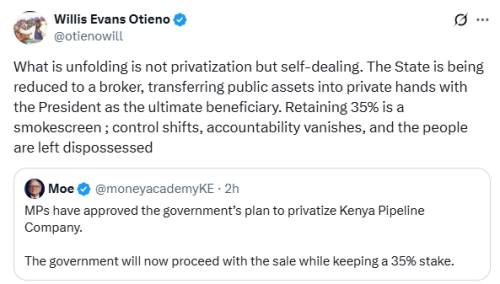
His remarks came a day after the National Assembly approved the government’s motion to privatise KPC. The heated session saw opposition MPs walk out, accusing the government of sneaking the motion into the order paper without proper consultation.
Opposition backlash
Opposition MPs argued that the planned sale is opaque and rushed. They insisted that the public was not consulted and threatened to challenge the move in court.
“The ground for this privatisation is a crooked process, all skewed to benefit a few people, and leave the Kenyan people poorer than they were,” said Funyula MP Dr Wilberforce Oundo.
Other opposition lawmakers echoed his concerns, saying the sale could push KPC into debt and hurt investors at the Nairobi Securities Exchange. They demanded transparency and meaningful public participation before such a major decision is taken.
“This issue of KPC will bring a lot of excitement, but after the announcement of the share capital in February for the full year, the share company will collapse and the share price will collapse. And this is the reason: the current investor in the NSE is not buying assets; they are buying revenue,” Kiharu MP Ndindi Nyoro said.

Kathiani MP Robert Mbui also vowed to challenge the process in court.
“The government has ambushed members on the motion to approve the privatisation. A matter as grave as this one should not be dealt with in such a casual manner,” he said.
Wiper Party leader Kalonzo Musyoka had also warned President William Ruto against selling the company. He described KPC as a “strategic” asset vital to the country’s energy sector.
“Ruto, don’t dare sell the Kenya Pipeline Company! If you attempt to fast-track the auction despite the court orders, we will come after you just like we did in the Adani-JKIA issue and stop it,” Kalonzo said in August.
Kalonzo reminded the government that the High Court had already issued conservatory orders blocking the privatisation pending a full hearing. The Consumer Federation of Kenya (Cofek), which filed the case, argued that selling a 65 per cent stake would deny Kenyans crucial revenue and expose the country to higher fuel costs.
Government defence
On the other hand, senior government officials have defended the plan. Trade Cabinet Secretary Lee Kinyanjui said privatisation should not be feared but seen as a normal global practice.
“Governments across the world were never designed for business. They are designed to create an environment for businesses to thrive. The moment we opened up Safaricom to private investment, it became Africa’s biggest,” Kinyanjui said.

He compared KPC’s planned sale to cases such as British Airways and Safaricom, insisting that privatisation would attract capital and improve efficiency.
ODM leader Raila Odinga also supported the idea, arguing that selling KPC would not remove the asset from the country.
“Even if you sell it, where is somebody taking it to? It remains here. The pipeline is underground,” Raila said in September during an ODM Parliamentary Group meeting.