Willis Otieno: Parliament’s bias has killed accountability in Kenya
By Kiprono Keileb, August 14, 2025Lawyer and political commentator Willis Otieno has criticised Parliament for abandoning its oversight role and siding with the Executive, warning that the move has eroded accountability in the country.
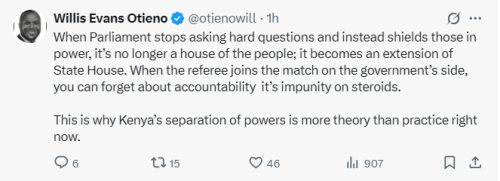
In a strongly worded statement posted on his X account on Thursday, August 14, 2025, Otieno said Parliament’s conduct has compromised Kenya’s democratic foundations and undermined the principle of separation of powers.
“When Parliament stops asking hard questions and instead shields those in power, it’s no longer a house of the people; it becomes an extension of State House,” he said.
Otieno compared the current state of parliamentary oversight to a football match where the referee openly favours one team, leaving the other side at a disadvantage. “When the referee joins the match on the government’s side, you can forget about accountability; it’s impunity on steroids,” he added.
The lawyer argued that the balance of power among the three arms of government, the Executive, the Legislature, and the Judiciary, has been undermined.. “This is why Kenya’s separation of powers is more theory than practice right now,” Otieno said.
His remarks come at a time when Parliament has faced criticism from sections of the public and civil society for what has been described as a “soft” approach toward holding the Executive to account. Critics argue that instead of questioning government actions and expenditure, lawmakers are increasingly seen defending the very institutions they are supposed to oversee.
Otieno’s statement also adds to the growing debate on the role of independent oversight in governance, with many Kenyans questioning whether Parliament still functions as a check on Executive power. In Kenya’s constitutional framework, Parliament is expected to scrutinise government policies, question expenditure, and ensure the interests of the people are safeguarded.
However, according to Otieno, this mandate has been watered down, leaving the public vulnerable to decisions made without proper scrutiny. His football analogy painted a picture of a democratic process where impartiality is lost and fairness no longer exists, making accountability almost impossible.
The separation of powers, enshrined in the Constitution, is meant to prevent any one arm of government from exercising unchecked authority. Otieno’s assertion that this principle is “more theory than practice right now” reflects concerns that the current political climate has tilted the scales in favour of the Executive.
The tone of his post conveyed a broader dissatisfaction with Parliament’s performance in fulfilling its duties. As Kenya continues to face governance and economic challenges, the question remains whether Parliament will reclaim its place as a true “house of the people” or remain, as Otieno warns, “an extension of State House.”
“When Parliament stops asking hard questions and instead shields those in power, it’s no longer a house of the people; it becomes an extension of State House,” he stated