Advertisement
Why Ruto face backlash over diplomatic missteps following Tanzania state visit?
Thursday 07th May, 2026 12:09 PM|

President William Ruto’s recent state visit to Tanzania, initially intended to reinforce diplomatic and economic ties between Nairobi and Dodoma, has instead triggered a fresh wave of criticism over what is described as a pattern of diplomatic missteps that continue to overshadow Kenya’s foreign policy posture.
The visit, which included a historic address to the Tanzanian Parliament in Dar es Salaam, was framed by both governments as a significant moment in strengthening East African cooperation. Kenyan and Tanzanian officials had indicated that discussions would focus on trade, infrastructure, regional security, and cross-border investments aimed at deepening integration within the East African Community (EAC).
However, controversy erupted even before President Ruto delivered his parliamentary address.
Earlier, before his address, faction within the Orange Democratic Movement (ODM), operating under the banner of Linda Mwananchi, criticised the visit, arguing that it risked legitimising what they termed a disputed political process in Tanzania under President Samia Suluhu Hassan.

You Might Also Like


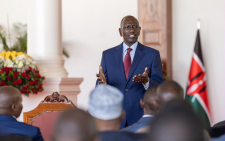
In a statement released shortly after Ruto arrived in Dar es Salaam on Monday, May 4, 2026, the group accused the Kenyan leader of abandoning Kenya’s longstanding image as a regional defender of democratic governance and constitutionalism.
“By addressing the Tanzanian parliament, Ruto is attempting to place Kenya’s stamp of legitimacy on a fraudulent regime and electoral process,” the statement said.
The faction further cited concerns raised by international observers regarding Tanzania’s political climate, including the detention of opposition leaders such as CHADEMA politician Tundu Lissu.
According to the group, the political environment in Tanzania remains tense and raises questions about democratic freedoms ahead of future electoral processes.
But it was not the opposition criticism alone that dominated headlines.
Ruto’s foreign affairs handball?
Instead, attention quickly shifted to an unexpected diplomatic embarrassment involving the announcement of a proposed oil refinery project in Tanga, Tanzania.
During public remarks, President Ruto spoke of plans for a multi-billion-shilling joint refinery project in the Tanzanian coastal city. The announcement appeared to catch Tanzanian authorities off guard, including President Samia Suluhu Hassan herself.
In an unusually candid response, Suluhu disclosed that she had only learned of the refinery proposal through media reports.
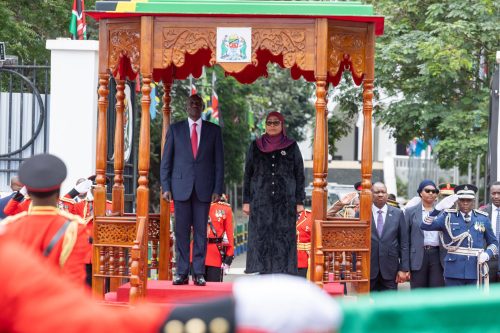
“While we were speaking inside, I pressed Ruto and asked him, ‘You went ahead and announced a refinery in Tanga, why was I not aware?’ He will explain himself,” Suluhu remarked.
Attempting to contain the fallout, Ruto later responded jokingly.
“I have been informed that my decision to announce the building of a refinery in Tanga has not sat well with you. If I knew, I would have announced that refinery to be built in Mombasa,” he said.
Yet the clarification did little to calm criticism back home, where concerns are growing over what some foreign policy experts describe as an increasingly impulsive diplomatic style.
Lies across the borders?
The Tanzania incident now joins a growing list of controversial remarks and foreign policy decisions that have repeatedly placed Ruto under scrutiny.
Only weeks earlier, Ruto stirred outrage in Nigeria after joking that Nigerians speak English in a manner that often requires translation.
“We speak some of the best English in the world. If you listen to a Nigerian speaking, you do not know what they are saying. You need a translator even when they are speaking English,” he said during a public event.
The remarks triggered backlash from Nigerians online and criticism from sections of the diplomatic community. Ruto later attempted to walk back the comments, describing them as harmless humour and referring to Nigerians as Kenya’s “in-laws” in a bid to ease tensions.
The repeated controversies are becoming increasingly costly for Kenya’s image abroad.
As Head of State and Kenya’s chief diplomat, President Ruto plays a central role in shaping the country’s foreign relations.
Traditionally, Kenya has cultivated a reputation as a stable diplomatic anchor in East Africa, often positioning itself as a mediator in regional conflicts and a promoter of multilateral engagement.
However, critics argue that Ruto’s unconventional communication style has occasionally undermined that legacy.
His administration has also faced questions over Kenya’s role in the UN-backed security mission in Haiti, where Kenyan police officers led multinational efforts to stabilise the violence-stricken Caribbean nation despite domestic legal and political opposition.
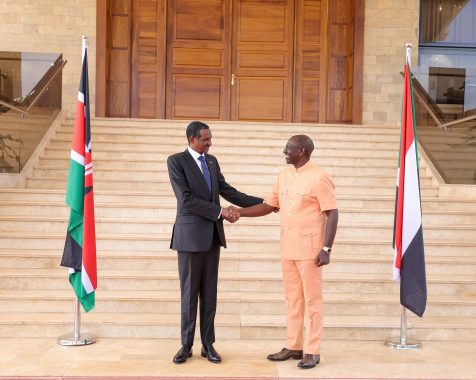
Similarly, Kenya’s decision to host leaders linked to Sudan’s Rapid Support Forces (RSF) previously strained relations with Khartoum and reportedly contributed to trade disruptions affecting Kenyan exports.
While Ruto’s energetic and direct diplomatic approach has helped position Kenya prominently on the global stage, repeated gaffes risk weakening the country’s soft power influence.
Author
Latest News





Advertisement
More on Inside Politics