Advertisement
Why court’s verdict on Maraga’s gender rule could influence 2027 polls
Friday 05th June, 2026 10:07 PM|
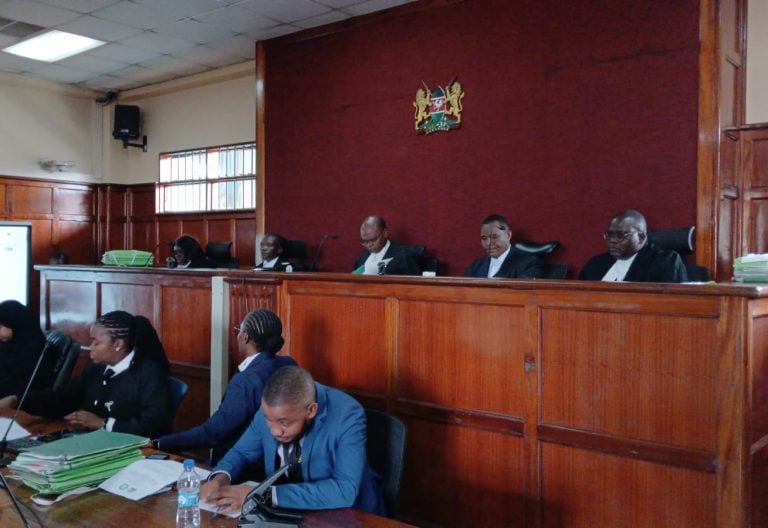
The High Court’s decision to strike down former Chief Justice David Maraga’s 2020 advisory opinion recommending the dissolution of Parliament has done more than settle a long-running constitutional dispute.
It has thrust the two-thirds gender principle back into the political spotlight, potentially shaping debates ahead of the 2027 General Election.
The ruling comes at a time when concerns are already mounting over the government’s commitment to implementing the constitutional requirement, with the issue recently emerging as one of the most contentious omissions in the report on the implementation of the ten-point agenda and the National Dialogue Committee (NADCO) recommendations.
Although a five-judge bench declared Maraga’s advisory unconstitutional, the judges simultaneously kept alive a key 2017 judgment directing Parliament to enact legislation implementing the constitutional gender requirement.
You Might Also Like



The verdict effectively shifts the focus from the question of dissolving Parliament to the unresolved issue of how Kenya will comply with one of the Constitution’s most contested provisions before the next election cycle.
The Constitution requires the State to take legislative and other measures to ensure that no more than two-thirds of members of elective and appointive bodies are of the same gender.
Yet more than a decade after the promulgation of the Constitution, Parliament has not enacted legislation to fully implement the requirement.

On Friday, June 5, 2026. judgment, the court acknowledged that Parliament had made several attempts to enact the law, including pursuing constitutional amendments aimed at giving effect to the principle.
However, the judges noted that none of the proposed amendments succeeded, either because they failed to attain the required threshold for passage or lacked quorum during voting.
Crucially, the judges held that the March 2017 High Court judgment directing Parliament to enact the legislation within 60 days remains valid.
“For this reason, it may still be transmitted to the Attorney-General and the Parliament,” the court said, adding that Parliament and the Attorney-General would determine the necessary steps towards enactment of the law and that time would begin running from the date of transmission.

“For these reasons, the evidence that we have given, we allow the petition and the advisory opinion by the Chief Justice Advisory dated 21 September 2020 is hereby declared unconstitutional.”
The decision means that although the dissolution route proposed in the advisory has been closed, the constitutional obligation to enact the gender rule law remains firmly in place.
That finding is likely to have significant political implications as parties, lawmakers and interest groups begin positioning themselves for the 2027 elections.
Any renewed effort to implement the two-thirds gender principle is expected to trigger fresh debate on representation, electoral reforms and the composition of legislative bodies.
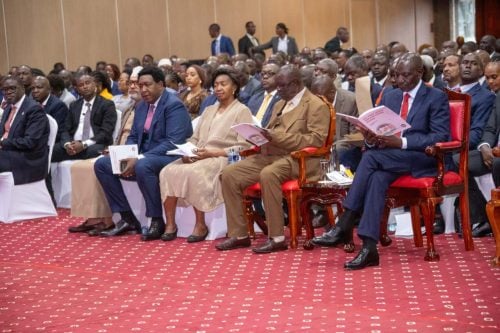
The NADCO report
The ruling also revives questions that recently surfaced during discussions around the implementation of the March 7, 2025 Memorandum of Understanding (MoU) between President William Ruto and the late Orange Democratic Movement (ODM) leader Raila Odinga.
The Agnes Zani-led committee tasked with implementing the ten-point agenda and NADCO recommendations came under criticism for failing to address the two-thirds gender issue in its report despite the matter remaining unresolved.
The omission drew criticism even from leaders allied to the government. United Democratic Alliance (UDA) Chairperson and Embu Governor Cecile Mbarire publicly questioned why the report was silent on a constitutional issue that has remained outstanding for years.
“Please say something about two third gender rule. It is silent in this report. You know how critical this matter is. It is very important that this is mentioned here and now,” she said amid interjections by President Ruto.
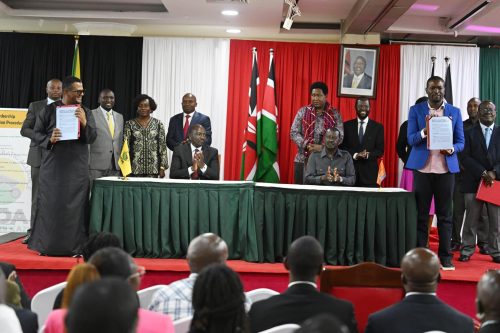
Her remarks came amid the growing political pressure surrounding the issue and highlighted how the gender principle could become a major campaign and governance question heading into the next election.
The dispute traces its roots to a March 2017 ruling by then High Court Judge John Mativo, who found that Parliament had failed to fulfil its constitutional mandate and ordered lawmakers to enact the required legislation within 60 days.
“I am satisfied that the first and second respondents have failed, refused and/or neglected to perform their constitutional mandate prescribed in the Constitution,” Justice Mativo ruled.
The case was filed by the Centre for Rights Education and Awareness (CREAW) and Community Advocacy and Awareness Trust (CRAWN Trust), which argued that Parliament’s failure to enact the law violated women’s rights and undermined constitutional guarantees on equality and inclusion.

In his 2020 advisory opinion, Maraga noted that several attempts had been made to pass legislation implementing the gender principle and that multiple petitions had been filed seeking enforcement of the Constitution.
“Yet that is the clear result Kenyans desired for Parliament’s failure to enact legislation they deemed necessary. Consequently, it is my constitutional duty to advise Your Excellence to dissolve Parliament under Article 261(7) of the Constitution,” Maraga stated in the advisory.
That advisory was subsequently challenged by Parliament and the Executive, leading to Friday’s ruling.
As the country moves closer to the 2027 elections, the verdict is likely to be remembered less for invalidating Maraga’s advisory and more for reigniting debate over a constitutional obligation that remains unfulfilled.
With the courts reaffirming that Parliament must still act, lawmakers now face renewed pressure to determine whether the two-thirds gender principle will finally be implemented before Kenyans return to the ballot.
Author
Latest News





Advertisement
More on Inside Politics