Advertisement
Why court’s cabinet ruling is a win for Ruto’s broad-based govt
Tuesday 30th June, 2026 10:33 PM|

President William Ruto secured a significant political victory after the High Court upheld the legality of his broad-based government, dismissing attempts to invalidate the appointment of opposition politicians to his Cabinet despite ruling that its current composition violates the Constitution’s two-thirds gender rule.
In a majority decision by Justices Eric Ogola and Stephen Githinji on Tuesday, June 30, 2026, the three-judge bench affirmed that Ruto acted within the Constitution when he reappointed Cabinet Secretaries he had dismissed in July 2024 and subsequently brought senior opposition figures into government following his political truce with the late former Prime Minister Raila Odinga.
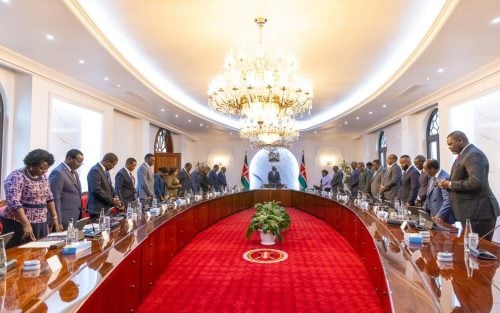
The court, however, directed the President to reconstitute the Cabinet within 120 days after finding that it fails to comply with Article 27(8) of the Constitution, which requires that no more than two-thirds of members of appointive public bodies be of the same gender.
“The current Cabinet does not comply with Article 27(8) of the Constitution because more than two-thirds of its members are of the same gender,” the court declared.
You Might Also Like



“Article 27(8) is immediate, mandatory and fully enforceable in relation to appointive public bodies and is not subject to progressive realisation.”
While the gender issue was the only successful constitutional challenge, the court rejected every other major petition challenging the President’s post-protest Cabinet appointments, effectively validating the broad-based government that brought opposition leaders into the Executive.
The petitions, filed by governance activist Wanjiru Gikonyo, the Kenya Human Rights Commission (KHRC) and Katiba Institute, had challenged the legality of reappointing ministers who had been dismissed after the July 2024 anti-government protests, as well as the inclusion of opposition politicians in Cabinet.
Following the dissolution of his entire Cabinet on July 11, 2024, Ruto entered into a political truce with Raila Odinga and unveiled a broad-based government that included senior opposition figures such as Treasury Cabinet Secretary John Mbadi, Mining Cabinet Secretary Hassan Joho, Energy Cabinet Secretary Opiyo Wandayi and Cooperatives Cabinet Secretary Wycliffe Oparanya. He also appointed Dorcas Oduor as Attorney-General.

Petitioners argued that the appointments violated the Constitution and undermined Kenya’s multiparty system. However, the majority of the judges found no constitutional basis for those claims.
“The President is granted the power to appoint and dismiss Cabinet Secretaries. Political inconsistency and legal inconsistency are not synonymous,” the court held.
The judges ruled that President Ruto was under no constitutional obligation to explain why he reappointed ministers he had earlier dismissed, noting that the July 2024 announcement dissolving the Cabinet was a political decision rather than a finding of wrongdoing against individual Cabinet Secretaries.
They also dismissed arguments that appointing politicians from parties outside the Kenya Kwanza coalition violated the Constitution, holding that Kenya’s Constitution neither establishes an official opposition nor bars the appointment of members of opposition parties to Cabinet or other State offices.
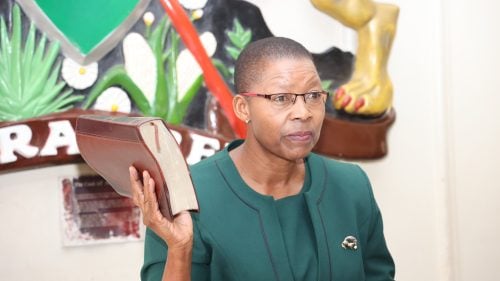
The court further upheld the appointment of Attorney-General Dorcas Oduor, finding that the Constitution does not require the office to be advertised and that no additional appointment procedure is prescribed beyond the constitutional process.
On Parliament’s role, the judges found that the National Assembly met constitutional standards during the vetting and approval of Cabinet nominees.
“The Constitution does not require a perfect process,” the judges said, adding that the parliamentary approval process complied with constitutional standards.
The bench also dismissed claims that the Cabinet failed to reflect regional balance, youth, persons with disabilities and marginalised groups, observing that a Cabinet limited to 25 members could not realistically accommodate every segment of society and that some representation requirements are subject to progressive realisation.
Looming cabinet shake-up?
Justice Jairus Ngaah dissented on the two key political questions, arguing that the President’s actions violated the Constitution.
“When the President frustrates the Constitution, it is the duty of the Court to rise up and safeguard the Constitution,” Justice Ngaah said.
He held that ministers dismissed on July 11, 2024, should not have been immediately reappointed because President Ruto had publicly linked their removal to shortcomings in the Cabinet’s performance.
“In nominating and reappointing members to the Cabinet that he had dismissed, the President acted contrary to Article 259 of the Constitution,” he said.
Justice Ngaah also concluded that appointing members of opposition political parties into Cabinet without a coalition or merger agreement under the Political Parties Act undermined Kenya’s constitutional system of multiparty democracy.
Despite the dissent, Justice Ngaah acknowledged that his opinion did not affect the outcome because he was outvoted by the majority, leaving the Cabinet’s failure to meet the two-thirds gender rule as the only successful constitutional challenge against President Ruto’s appointments.
Author
Latest News






Advertisement
More on Inside Politics