What Ruto didn’t tell Kenyans after announcing crackdown on goons
By David Nthua, July 22, 2026President William Ruto has promised a nationwide crackdown on goons and political violence.
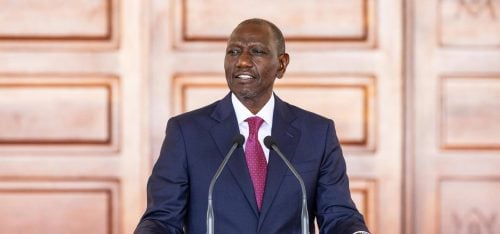
Speaking at State House, Nairobi, on Tuesday, July 21, 2026, Ruto said criminal conduct could not be defended as youth activism.
“There cannot be any defence for criminality and for breaking the law,” Ruto said.
“Now that we have consensus, our security agencies must do their job within the law and stop criminality.”
The declaration addressed the people committing violence. It did not fully address the political and economic system producing them.
It also left unanswered questions about financiers, organisers and people providing vehicles, weapons or protection.
That omission matters after the Ol Kalou by-election. Masked and armed men were filmed travelling in unmarked vehicles, firing into the air and deploying tear gas near polling stations.
Journalists were assaulted despite the deployment of more than 1,000 police officers. The Directorate of Criminal Investigations is now investigating the perpetrators, planners and financiers.
Why desperate youths accept dangerous work
Political goonism cannot be blamed entirely on unemployment. Thousands of unemployed Kenyans reject violence every day.
However, science explains why financial desperation can make dangerous political assignments more attractive.
A peer-reviewed study published in Science found that financial scarcity consumes mental resources. Immediate financial problems can reduce the attention available for weighing other consequences.
Researchers call this a loss of “mental bandwidth.” The brain focuses on the urgent problem, such as food, rent or debt, while distant dangers receive less attention.

This does not remove personal responsibility. It does explain why Ksh1,000 offered immediately can appear more important than the possibility of apprehension, injury or prosecution later.
The Kenyan economy provides a ready recruitment pool.
About 87.2 per cent of the 822,100 jobs created in 2025 were in the informal economy. Such jobs often provide unstable incomes and limited social protection.
Inflation reached 6.4 per cent in June 2026. Food prices increased by 8.6 per cent, while transport costs rose by 16.1 per cent, according to the Kenya National Bureau of Statistics.
A crackdown that only apprehends young people will therefore treat the symptoms.
Public employment initiatives such as Kazi Mtaani can reduce vulnerability by providing legal income, structure and work experience.
The programme has previously trained more than 200,000 young people in entrepreneurship, life skills and financing, according to the State Department for Youth Affairs.
Skills training alone is not enough. Rehabilitation services, counselling and economic support are also necessary.
A long-term experimental study involving high-risk men in Liberia found that cognitive behavioural therapy reduced robbery, drug dealing and street fighting. The strongest results came when therapy was combined with financial assistance.
The study does not prove that the same intervention would produce identical results in Kenya. It shows that enforcement works better when accompanied by income and behavioural support.
Why financiers keep returning
Behavioural science also explains why political organisers continue financing violence.
People repeat conduct that produces rewards without serious consequences. In politics, the reward can be disrupting a rival’s meeting, frightening voters or controlling media coverage.
If only street-level actors are apprehended, the organiser’s expected cost remains low.
Research summarised by the United States National Institute of Justice shows that the certainty of being caught deters crime more effectively than threats of severe punishment.
That means repeated presidential warnings will have limited effect if financiers believe they will remain unnamed and untouched.
A credible crackdown must trace mobile-money payments, vehicles, telephone communication and operational commands. It must also establish whether security officers acted, failed to act or faced interference.
Ruto issued a similar directive in December 2025. He ordered the Inspector-General to pursue leaders using young people to cause violence.
The latest promise will be judged differently. Kenyans will expect public identification of organisers, evidence-based prosecutions and equal enforcement across political parties.
Goonism has a supply side and a demand side. Empowerment, rehabilitation and counselling can reduce the supply.
Only certain apprehension and prosecution of financiers will destroy the demand.