Advertisement
Wajir governor dares Gachagua over school remarks on Northern Kenya leaders
Saturday 10th January, 2026 10:31 PM|

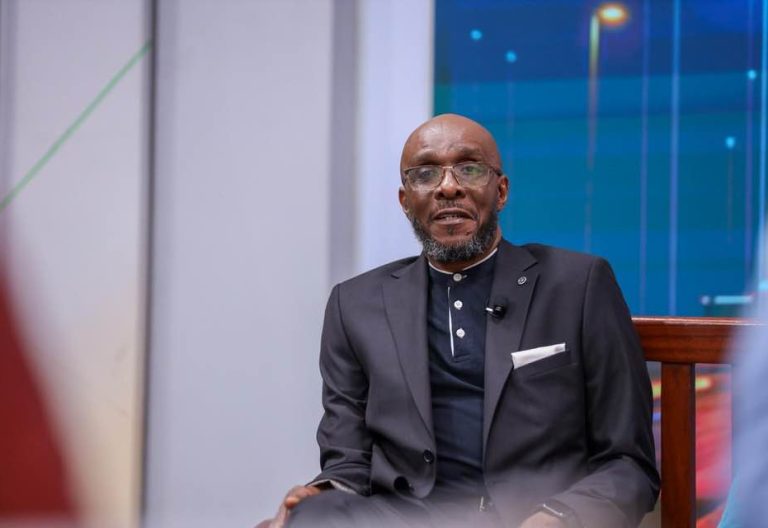
Wajir County Governor Ahmed Abdullahi has fired back at former Deputy President Rigathi Gachagua after he criticised leaders from Northern Kenya, questioning their investment in public institutions despite what he described as “massive resources” allocated to their counties under devolution.
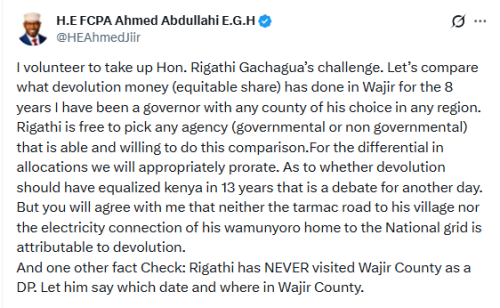
Taking to his official X account on Saturday, January 10, 2026, Governor Abdullahi dared Gachagua to agree to a challenge where they would compare what devolution money (equitable share) has done in Wajir for the last eight years he has been a governor with any county of his choice in any region.
“I volunteer to take up Hon. Rigathi Gachagua’s challenge. Let’s compare what devolution money (equitable share) has done in Wajir for the 8 years I have been a governor with any county of his choice in any region,” Abdullahi wrote on X.
Auditing
The county boss further challenged Gachagua to pick any agency of his choice that would be able and willing to do the comparison.
You Might Also Like

“Rigathi is free to pick any agency (governmental or non-governmental) that is able and willing to do this comparison. For the differential in allocations, we will appropriately prorate. As to whether devolution should have equalised Kenya in 13 years, that is a debate for another day,” he stated.
He went on to claim that some developments, such as the tarmacking of roads and electricity distribution, are not a mandate of devolution. Governor Abdullahi also claimed that Gachagua never visited Wajir County during his time as the second in command.
“But you will agree with me that neither the tarmac road to his village nor the electricity connection of his wamunyoro home to the National grid is attributable to devolution.
And one other fact Check: Rigathi has NEVER visited Wajir County as a DP. Let him say which date and where in Wajir County,” the governor stated.
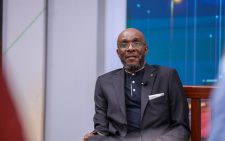
Gachagua’s remarks
Gachagua, during a press conference on Friday, January 9, 2026, questioned the Northern Kenya leaders’ investment in public institutions despite what he described as “massive resources” allocated to their counties under devolution.
Gachagua said leaders from the region should not lecture others about affirmative action, adding that 13 years after devolution began, the argument that some counties should continue receiving preferential treatment in the placement of students to national schools may no longer be justified.
“Devolution has been in place since 2013, and leaders from those regions have not developed institutions at the same pace, yet they want their children to benefit from facilities established by other counties,” he said.
“They have the opportunity to develop institutions of the highest standards possible in Kenya, not just for the children of those areas, but for the children of Kenya,” he said, adding that comparable counties in the Western, Rift Valley, and Mt Kenya regions had used smaller amounts to establish “beautiful institutions”.
Gachagua noted that during his tenure as deputy president, he observed limited development in Northern Kenya despite sustained transfers of public funds.
“I travelled as deputy president to those areas, and I did not see new institutions corresponding to the level of funding received,” he claimed.v
Author
Mustafa Juma
View all posts by Mustafa JumaLatest News



Advertisement
More on Inside Politics