Advertisement
‘They called me tribal’ – Gachagua hits back over ID issuance controversy
Monday 15th June, 2026 01:17 PM|

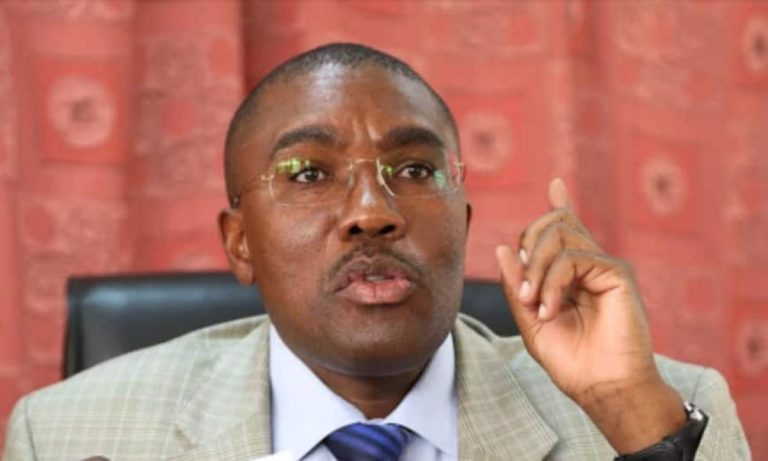
Former Deputy President Rigathi Gachagua has used growing concerns over the issuance of Kenyan identity cards and passports to launch a fresh attack on President William Ruto’s administration, accusing his critics of hypocrisy.
In a Facebook post published on Monday, June 15, 2026, Gachagua sarcastically revisited accusations that he promoted tribalism while serving in government, arguing that those who levelled the claims against him are now presiding over a far more serious crisis involving national security and the integrity of Kenya’s identification system.
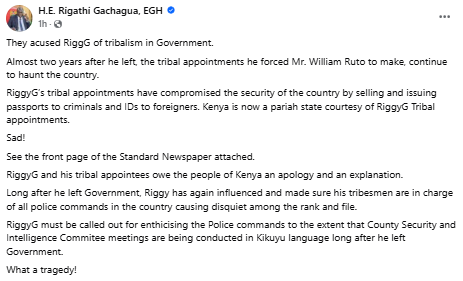
“They accused RiggyG of tribalism in government. Almost two years after he left, the tribal appointments he forced Mr William Ruto to make continue to haunt the country,” Gachagua wrote.
The former Deputy President’s remarks were accompanied by what appeared to be a reference to recent media reports and investigations into the claimed issuance of Kenyan passports and identity cards to foreigners and criminals.
You Might Also Like


The post was clearly written in a sarcastic tone. Throughout the statement, Gachagua repeatedly referred to himself in the third person while mocking accusations that his claimed “tribal appointments” were responsible for problems currently facing government institutions.
“RiggyG’s tribal appointments have compromised the security of the country by selling and issuing passports to criminals and IDs to foreigners. Kenya is now a pariah state courtesy of RiggyG tribal appointments,” he stated.
For several years, Gachagua’s political opponents accused him of pushing for appointments that favoured people from the Mt Kenya region. The claims intensified during his tenure as Deputy President, with critics arguing that public appointments should reflect the country’s ethnic diversity.
Gachagua consistently rejected those accusations and maintained that he was fighting for fair representation and equitable distribution of government opportunities.
His latest statement appears designed to turn those accusations against the current administration.
The comments come at a time when questions surrounding Kenya’s identification and passport systems have become a major political issue.
Passport and ID concerns
Recent media investigations have highlighted cases in which foreigners allegedly acquired Kenyan identity cards and passports through fraudulent processes. The reports have raised concerns among security experts because national identification documents are central to citizenship verification, border control, voting registration and access to public services.
The issue has also attracted attention from politicians across the political divide.
Former Public Service Cabinet Secretary Justin Muturi recently questioned reports that foreigners were obtaining Kenyan identity cards while some Kenyan citizens continued to experience delays in accessing the documents.
Muturi claimed residents in border counties had complained about non-citizens receiving IDs faster than Kenyans, raising concerns about the integrity of the registration system.
The controversy has emerged alongside major reforms introduced by President William Ruto’s administration to expand access to identification documents.
In February 2025, the government abolished the long-standing vetting process that residents of several border counties had previously undergone before obtaining national identity cards.
The administration argued that the vetting requirement unfairly discriminated against citizens from regions such as Wajir, Mandera and Garissa.
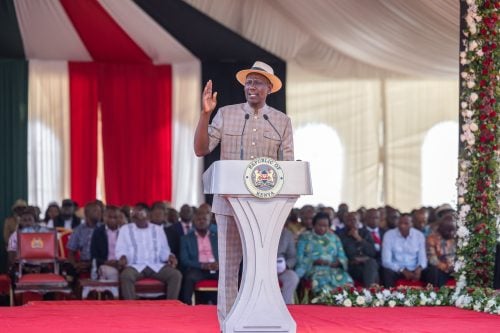
Speaking during a mass registration exercise in Migori County earlier this year, Interior Principal Secretary Raymond Omollo defended the reforms.
“His Excellency President Ruto took away the requirement for extra vetting for the residents of those counties so that they could be able to access identification documents just like the rest of Kenyans,” Omollo said.
ID applications and replacements
The government also removed fees for first-time ID applications and replacements. In addition, Interior Cabinet Secretary Kipchumba Murkomen announced a second phase of mobile ID registration targeting remote and marginalised communities where many adults remain undocumented.
Government officials insist that the reforms are intended to promote equal citizenship and improve access to public services. They maintain that security safeguards remain in place through biometric verification and digital registration systems.
However, critics argue that any effort to widen access to identity documents must be accompanied by strong oversight mechanisms to prevent abuse.
In his latest statement, Gachagua linked the ongoing controversy to broader concerns about appointments within government institutions.
He claimed that individuals who previously accused him of tribalism should explain the current state of affairs and answer questions being raised about national security and public administration.
The former Deputy President also claimed that police command structures had become heavily influenced by ethnic considerations, though he did not provide evidence to support the claim.
Author
Kenneth Mwenda
Kenneth Mwenda is a business, sports, and politics digital writer with over seven years of experience in journalism, covering breaking news, feature stories, and in-depth analysis across a range of beats.
For inquiries, he can be reached at [email protected]
View all posts by Kenneth MwendaLatest News








Advertisement
More on Inside Politics