Advertisement
Ruto dismisses Gachagua’s claims of political agenda in Wajir trip
Tuesday 02nd June, 2026 01:42 AM|

President William Ruto has dismissed accusations from opposition leaders that his visit to Wajir County during Madaraka Day celebrations on Monday, June 1, 2026, was politically motivated rather than focused on development.
He made the remarks during a roundtable engagement with journalists from the North Eastern region.
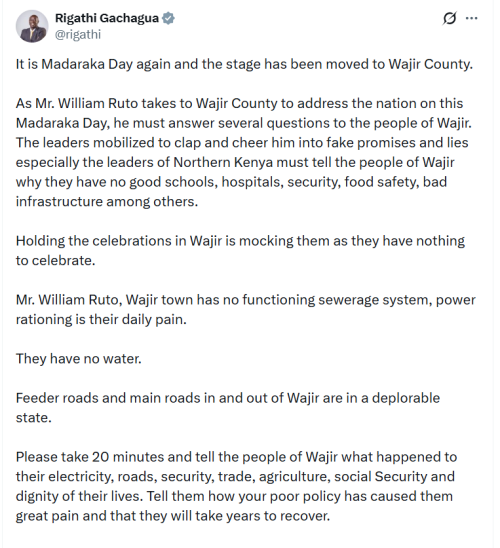
The opposition, led by former Deputy President Rigathi Gachagua, had criticised the decision to hold national celebrations in Wajir.
In a post on X dated June 1, 2026, Gachagua raised concerns about infrastructure and service delivery in the county, citing challenges including water access, electricity supply, roads, and sanitation. He also questioned the use of devolution funds and called for accountability on historical grievances, including the Wagalla massacre.
You Might Also Like
Gachagua argued that hosting Madaraka Day in Wajir overlooked ongoing challenges faced by residents. He listed issues affecting daily life, including inadequate sewerage systems, power rationing, and poor road infrastructure.
He further questioned investments in the region since the introduction of devolution and raised concerns about security, trade, agriculture, and social services. He also called for an apology over past incidents affecting the region.
The remarks formed part of wider opposition criticism of the government’s development priorities and spending decisions.
Ruto defends leadership and rejects political claims
Responding to the criticism, President Ruto said his actions are guided by national interest and not political convenience. “Those on the other side, they are entitled to their opinion,” he said.
“I don’t do things and I have never done things for convenience or to push a political agenda. What I do is that which I believe in, in me, that is right for Kenya,” Ruto added.
The president reflected on his role in office, describing it as a significant national responsibility.
“My friend, it’s not always that one becomes president of a country. It’s the highest honour anybody can be. And therefore, I don’t take it for granted that a person with not so much background like me today is the leader of a great nation like Kenya. So I take it very seriously.”
He noted that he is often perceived as highly active in his leadership approach but said this is driven by commitment to national duties.
“I take this responsibility very, very seriously. I take the fact that I am the leader of this nation very seriously, and I apply my mind to it. I deploy my energy. I do everything that I can to make sure that I move this country to the next level.”
Governance context and regional development focus
Ruto’s remarks come amid ongoing debate over development disparities and service delivery in northern Kenya. The region has faced long-standing infrastructure and social service challenges, which continue to shape political discussions between government and opposition leaders.
The exchange highlights differing views on development priorities and the role of national events in regional inclusion. The government maintains that its engagements across counties are aimed at strengthening unity and accelerating development initiatives.
The Madaraka Day celebrations in Wajir formed part of broader state functions held outside Nairobi to promote national integration and highlight development needs across counties.
Author
Latest News

Advertisement
More on Inside Politics