Advertisement
Otieno Willis slams leaders for ethnic politics, calls for unity
Sunday 03rd August, 2025 06:32 AM|
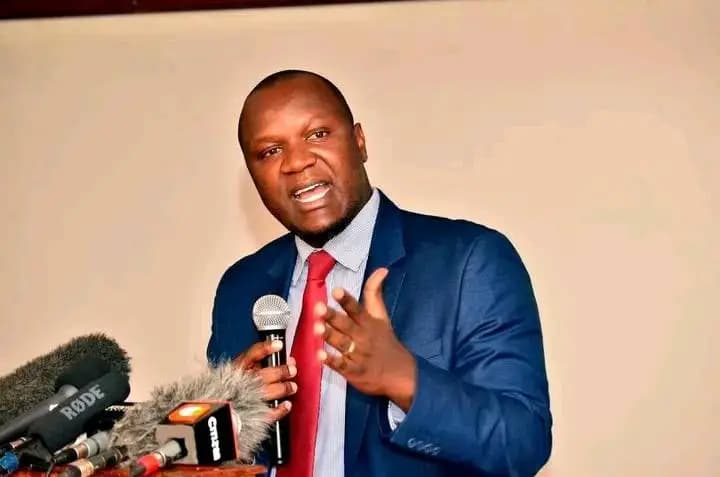
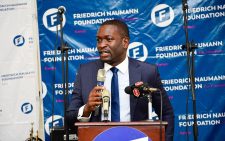
Political commentator and constitutional lawyer Willis Evans Otieno has criticised National Assembly Speaker Moses Wetang’ula for advancing tribal-based politics, calling on Kenyans to rise above ethnic divisions and embrace a shared national identity.
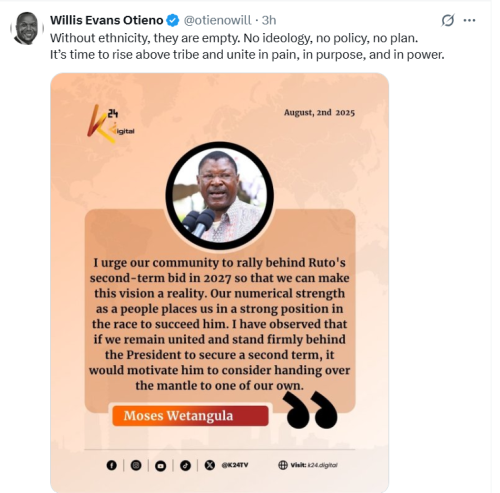
In a post shared on his official X account early Sunday, August 3, 2025, Otieno wrote, “Without ethnicity, they are empty. No ideology, no policy, no plan. It’s time to rise above tribe and unite in pain, in purpose, and in power.”
His remarks were in direct response to Wetang’ula’s recent appeal to the Luhya community to rally behind President William Ruto’s re-election bid in 2027.
Wetang’ula’s succession pitch
Speaking earlier in the week, Wetang’ula urged the Luhya community—commonly referred to as the Mulembe nation—to support Ruto’s second-term bid, saying such unity would improve the community’s chances of producing the next president.
You Might Also Like


“I urge our community to rally behind Ruto’s second-term bid in 2027 so that we can make this vision a reality. Our numerical strength as a people places us in a strong position in the race to succeed him,” Wetang’ula said, suggesting that loyalty to Ruto would increase the likelihood of a Luhya successor.
His comments reflect long-standing political strategies that revolve around ethnic mobilisation to build coalitions, especially in regions seen as key voting blocs. In the past, the Luhya vote has played a decisive role in presidential contests, including in the 2002 election that brought Mwai Kibaki to power.
Ideology over tribe
Otieno, however, dismissed Wetang’ula’s pitch as retrogressive and counterproductive. He accused the Speaker and other political leaders of using ethnicity as a political tool while ignoring urgent national challenges such as public debt, economic inequality, and governance reforms.
“These tactics do nothing but entrench division in a country already struggling with systemic inequality, unemployment, and unrest,” he noted, urging a shift toward issue-based politics and leadership that transcends tribal loyalty.
Wetang’ula, a close ally of President Ruto, has consistently defended the Kenya Kwanza administration’s track record. On July 13, while attending a church service in Igembe North, Meru County, he praised the government’s performance and urged Meru residents to support Ruto’s re-election.
Rising tide of dissent
Otieno’s statement is the latest in a series of public critiques targeting senior government officials. On July 31, he took on Interior Cabinet Secretary Kipchumba Murkomen over remarks downplaying police brutality during recent protests, accusing him of enabling impunity.
Otieno’s growing influence among reform-minded Kenyans signals a shift toward issue-based engagement as the country heads into another heated election cycle.
Author
Latest News




Advertisement
More on Inside Politics
