Nyong’o warns ODM against losing its soul amid rising party wrangles
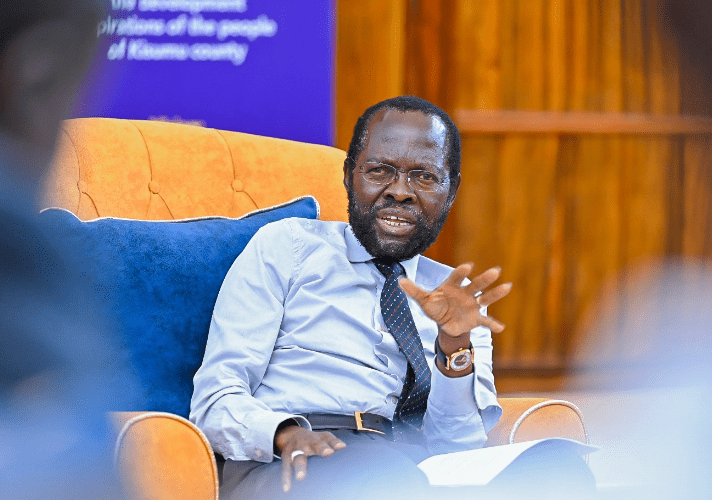
By Mustafa Juma, March 8, 2026Kisumu Governor Anyang’ Nyong’o has warned that the Orange Democratic Movement (ODM) risks drifting away from its founding ideals if it fails to address internal wrangles and return to the principles that shaped the party two decades ago.
In a lengthy statement shared via his official Facebook account on Sunday, March 8, 2026, Nyong’o said the party must remain faithful to the reformist ideals that emerged during the historic push for constitutional change in Kenya.
The Kisumu governor, who described himself as one of the pioneers of the party and its former secretary general, said political parties are not accidents of history but products of moral and political necessity.
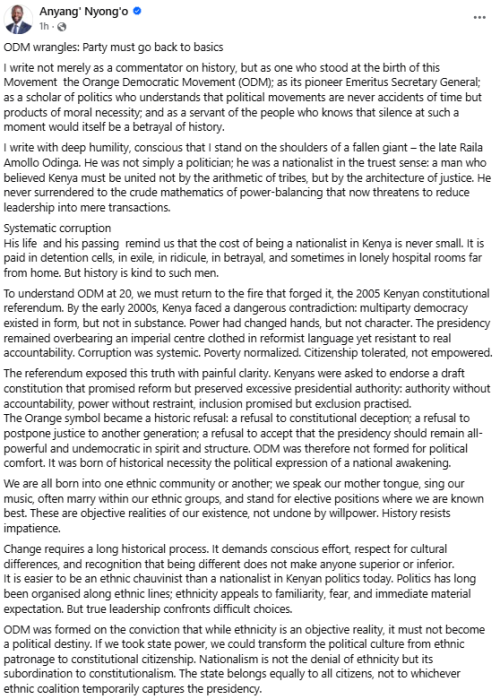
“ODM wrangles: Party must go back to basics. I write not merely as a commentator on history, but as one who stood at the birth of this Movement the Orange Democratic Movement (ODM); as its pioneer Emeritus Secretary General; as a scholar of politics who understands that political movements are never accidents of time but products of moral necessity; and as a servant of the people who knows that silence at such a moment would itself be a betrayal of history,” Nyong’o stated.
Origin of ODM
Nyong’o traced the origins of ODM to the historic 2005 Kenyan constitutional referendum, when a coalition of reformists rejected a proposed constitution that they believed preserved excessive presidential powers.
“To understand ODM at 20, we must return to the fire that forged it, the 2005 Kenyan constitutional referendum. By the early 2000s, Kenya faced a dangerous contradiction: multiparty democracy existed in form, but not in substance. Power had changed hands, but not character. The presidency remained overbearing an imperial centre clothed in reformist language yet resistant to real accountability. Corruption was systemic. Poverty normalized. Citizenship tolerated, not empowered,” Nyong’o said.
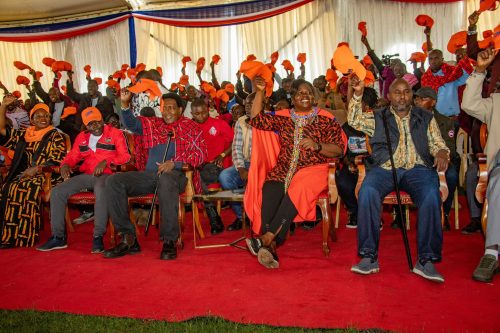
“The Orange symbol became a historic refusal: a refusal to constitutional deception; a refusal to postpone justice to another generation; a refusal to accept that the presidency should remain all-powerful and undemocratic in spirit and structure. ODM was therefore not formed for political comfort. It was born of historical necessity, the political expression of a national awakening.”
Role of the 2010 Constitution
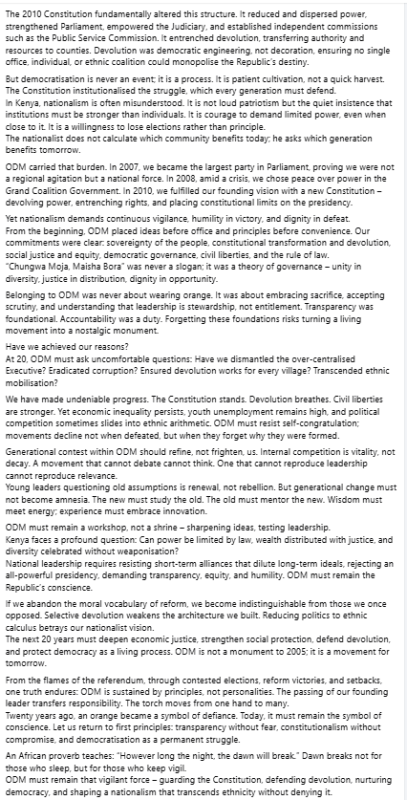
Nyong’o said the party played a major role in pushing for the reforms that eventually produced the 2010 Constitution of Kenya, which introduced sweeping changes, including devolution, stronger parliamentary oversight, and an independent judiciary.
He noted that the new constitutional framework sought to dismantle the culture of a highly centralised presidency that had long shaped Kenya’s political competition.
The introduction of devolution, he said, was intended to distribute power and resources more equitably across counties, reducing the perception that the presidency controlled the nation’s wealth and opportunities.
Call for internal reflection
Despite these achievements, Nyong’o said ODM must confront difficult questions about whether it has remained true to its founding ideals.
Among the issues he highlighted were persistent corruption, economic inequality, and the continued use of ethnic mobilisation in political competition.
“Movements decline not when they are defeated, but when they forget why they were formed,” he said.
Nyong’o also encouraged generational renewal within the party, saying younger leaders challenging older leadership structures should not be seen as rebellion but as a sign of political vitality.
However, he cautioned that generational change must not erase institutional memory or the ideological foundations that built the party.
Defending the reform agenda
Nyong’o stressed that ODM must remain committed to constitutionalism, devolution, social justice, and democratic governance.
He warned that abandoning these ideals could reduce the party to what he described as a “nostalgic monument” rather than a living political movement.
“ODM is not a monument to 2005; it is a movement for tomorrow,” Nyong’o said.
As Kenya continues to grapple with governance challenges, Nyong’o urged the party to maintain its role as a guardian of constitutional reforms and democratic principles.
“From the flames of the referendum, through contested elections, reform victories, and setbacks, one truth endures: ODM is sustained by principles, not personalities. The passing of our founding leader transfers responsibility. The torch moves from one hand to many. Twenty years ago, an orange became a symbol of defiance. Today, it must remain the symbol of conscience. Let us return to first principles: transparency without fear, constitutionalism without compromise, and democratisation as a permanent struggle,” he said.