Morara Kebaso: Kenyans voting along tribal lines are choosing poverty
By Kiprono Keileb, February 10, 2026Human rights activist Morara Kebaso has urged Kenyans to consider the consequences of voting based on tribal loyalty rather than national interest, cautioning that such decisions deepen poverty and empower corruption.
In a statement shared on X on Tuesday, February 10, 2026, Morara Kebaso expressed concern that many hardworking citizens are inadvertently supporting leaders who have historically abused public trust.

“The poor and suffering Kenyans who pay taxes are the same ones who are voting for thieves along tribal lines. Ukiwaambia wanakutusi ama wanasema umelipwa,” Morara Kebaso stated.
He further explained that political slogans and songs have become a trap, luring voters into supporting corrupt systems under the guise of loyalty and identity politics.
“The ones singing tutam are preparing to vote for poverty through a corrupt government,” he wrote.
Kebaso also pointed out that even opposition parties that once had a record of corruption are not immune, and that tribal loyalty can blind citizens to ongoing governance failures.
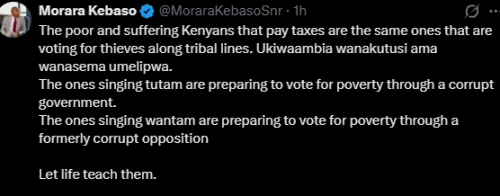
“The ones singing wantam are preparing to vote for poverty through a formerly corrupt opposition,” he stated.
The lawmaker urged Kenyans to prioritise accountability, transparency, and national development over narrow ethnic considerations when casting their ballots. He stressed that voting decisions affect everyone, especially those already struggling to make ends meet, and that continued support for corrupt leaders perpetuates cycles of poverty and inequality.
He concluded that the future of Kenya depends on the electorate making informed decisions that prioritise the nation’s growth, not just short-term tribal allegiances.
Morara’s calls for civic education to address rural voting patterns in Kenya
Kebaso urged for intensified civic education to change rural voting patterns in Kenya, warning that without such efforts, rural voters could continue to shape governance and economic outcomes for generations.
He noted that in Bangladesh, Generation Z wisely formed a citizens’ party, achieving significant success in urban areas. However, he observed, rural voters remained a challenge, highlighting a common pattern across countries where entrenched local loyalties often shape political outcomes.
He explained that Kenya faces a similar dynamic. When Gen Z started gaining political momentum, President William Ruto responded with tours in rural villages, recognising that rural voters still hold decisive influence over national elections.
“In Kenya, when the GenZ were hot on Ruto’s heels, he started tours in rural villages. Unless we fix the rural voter through civic education, they will determine the quality of our governance and economy for a long time to come, and we will be helpless,” he stated.