Lawyer Willis Otieno explains why Kenyan leaders struggle with accountability
By Cynthia Lodite, February 10, 2026City lawyer Willis Otieno has raised concerns over the accountability actions of Kenyan leaders, describing them as a deeply entrenched reluctance to submit to accountability.
In a series of posts on his official X account on Tuesday, February 10, 2026, the lawyer explained why most leaders struggle with accountability, which he says dates back to their first day of assuming power.
While the impact of ignoring accountability seems to widen in Kenya, Otieno notes how the issue of accountability trickles down from senior government officials, which often leads to a pattern of authority without accountability.
“This culture does not begin at the periphery; it cascades from the summit of power. From the presidency down through governors, senators, MPs, and the wider political elite, a pattern emerges: authority without answerability,” Otieno stated.
Willis Otieno has further argued that, indeed, ethical discipline has collapsed at the top, slowly crippling service delivery at the subordinate institution.
“As the old adage warns, “the fish rots from the head downward.” When ethical discipline collapses at the top, decay inevitably seeps into every subordinate institution, normalising excess, excusing impunity, and institutionalising arrogance,” he added.
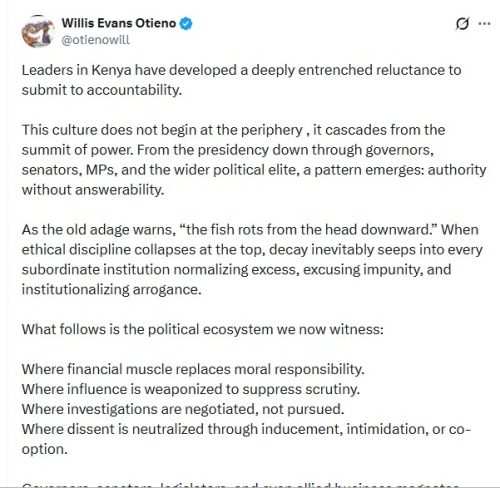
Outcome of unaccountability
The renowned lawyer further explains that with a lack of accountability in various government institutions, what follows is the political ecosystem, which he says ‘we now witness’.
“Where financial muscle replaces moral responsibility. Where influence is weaponised to suppress scrutiny. Where investigations are negotiated, not pursued. Where dissent is neutralised through inducement, intimidation, or co-option,” Otieno
He went on, noting that governors, senators, legislators, and even allied business magnates increasingly operate within a shielded class insulated by money, proximity to power, and networks of protection.
Hence, accountability becomes performative, while oversight becomes selective, and justice becomes transactional.
“In such an environment, money and power mutate into the dominant currencies of governance deployed not to serve the public, but to preserve privilege and extinguish consequences,” he explained.
“So the nation waits. waiting as leaders forget the source of their mandate, waiting as service is replaced by entitlement. Waiting as the public office drifts further from public duty. Because when those entrusted to steward the republic begin to act above it,” Otieno added.
His sentiments come at a time when governors and senators are engaged in a bitter squabble with county bosses, accusing the lawmakers of harassment. The tension escalated with governors threatening to suspend their appearances before Senate committees.
Responding to governors’ concerns, Senate Speaker Amason Kingi insisted that governors are obliged to honour summons as stipulated in the constitution.