Karua blasts Ichung’wah for comparing Kenya’s fuel prices to London
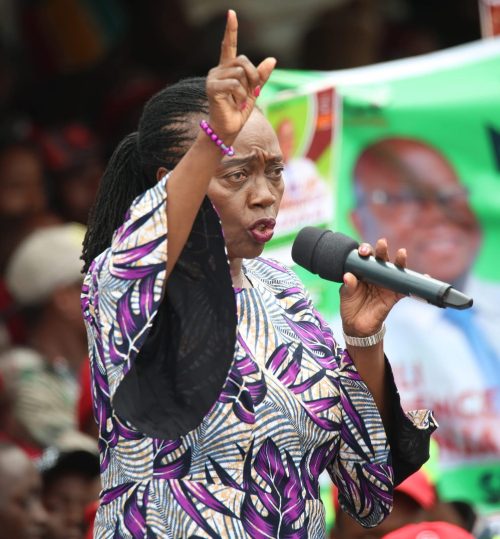
By Mustafa Juma, April 20, 2026People’s Liberation Party (PLP) leader Martha Karua has sharply criticised Kikuyu Member of Parliament (MP) Kimani Ichung’wah over his comparison of Kenya’s fuel prices to those in London.
Taking to her official X account on Monday, April 20, 2026, Karua termed the comparison out of touch with the reality facing ordinary Kenyans.
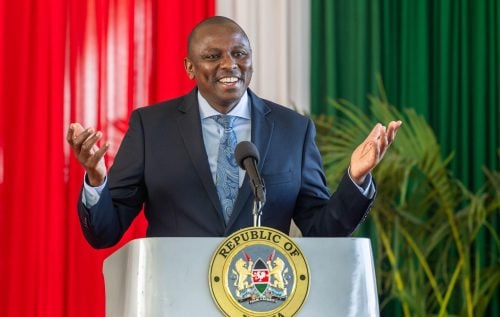
Ichung’wah had defended current fuel prices by pointing to higher costs in the United Kingdom, noting that diesel and petrol prices in London are significantly above those in Kenya.
He also credited President William Ruto’s administration for reducing VAT on fuel from 16 per cent to 8 per cent to cushion consumers.
However, Karua dismissed the comparison, arguing that it ignores the economic realities of Kenyan citizens whose incomes remain significantly lower.
She urged leaders to focus on the lived experiences of ordinary people rather than drawing parallels with developed economies.
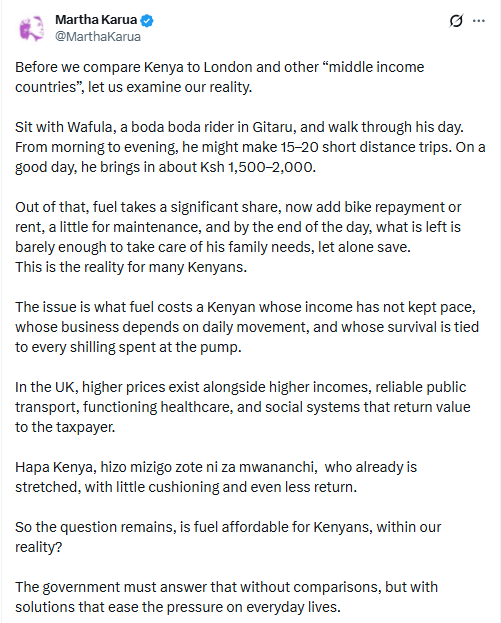
“Before we compare Kenya to London and other “middle income countries”, let us examine our reality,” she stated.
The Boda Boda example
To illustrate her point, Karua painted a vivid picture of a typical Kenyan worker, referencing a boda boda rider in Gitaru struggling to make ends meet.
According to her, a rider may earn Ksh 1,500–2,000 on a good day, but fuel consumes a large portion of that income. Additional costs like loan repayments and maintenance would further reduce the earnings.
She argued that by the end of the day, many such workers are left with barely enough to sustain their families, let alone save.
“Sit with Wafula, a boda boda rider in Gitaru, and walk through his day. From morning to evening, he might make 15–20 short distance trips. On a good day, he brings in about Ksh 1,500–2,000,” Karua wrote on X.
“Out of that, fuel takes a significant share, now add bike repayment or rent, a little for maintenance, and by the end of the day, what is left is barely enough to take care of his family needs, let alone save. This is the reality for many Kenyans.”
Income gap
Karua emphasised that the real issue is not just fuel prices but affordability relative to income.
She contrasted Kenya with the UK, where higher fuel prices are offset by higher wages, reliable public transport systems, strong healthcare and social safety nets.
In Kenya, she said, citizens bear the full burden without comparable support systems.
“The issue is what fuel costs a Kenyan whose income has not kept pace, whose business depends on daily movement, and whose survival is tied to every shilling spent at the pump,” she stated.
“In the UK, higher prices exist alongside higher incomes, reliable public transport, functioning healthcare, and social systems that return value to the taxpayer. Hapa Kenya, hizo mizigo zote ni za mwananchi, who already is stretched, with little cushioning and even less return. So the question remains, is fuel affordable for Kenyans, within our reality?”
Karua also challenged the government to move away from international comparisons and instead provide practical solutions to ease the pressure on Kenyans.
“The government must answer that without comparisons, but with solutions that ease the pressure on everyday lives,” she said.
Ruto on fuel price comparison
Karua’s remarks come a day after President Ruto explained why fuel prices in Kenya often remain higher than in neighbouring countries, pointing to the country’s middle-income status and tax structure.
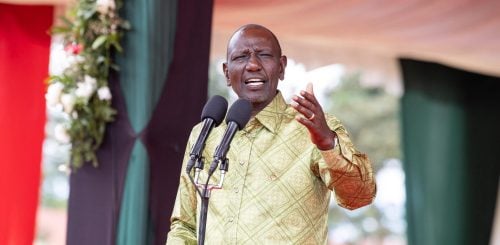
Speaking during a Sunday service at Karen Africa Gospel Church on April 19, 2026, Ruto said comparisons between Kenya and its neighbours are often misleading.
“I know many people in Kenya keep asking, you know, why is it that sometimes prices of fuel are different in Kenya from our neighbours? Sometimes maybe it’s good to let them know, because it’s important for people to know,” he said.
He said the first reason is Kenya’s economic classification.
“Kenya is a middle-income country. Our neighbours are the least developed countries. There is a big difference,” he said.
Ruto added that fair comparisons should be made with countries of a similar economic level.
“If you want to compare Kenya fairly with others, compare Kenya with other middle-income countries. That is how you will get the figures right. Middle-income countries like Kenya are possibly have higher prices than Kenya or the same,” he said.