Advertisement
Kalonzo honours Saba Saba heroes, accuses police of violating protest rights
Tuesday 07th July, 2026 06:30 PM|
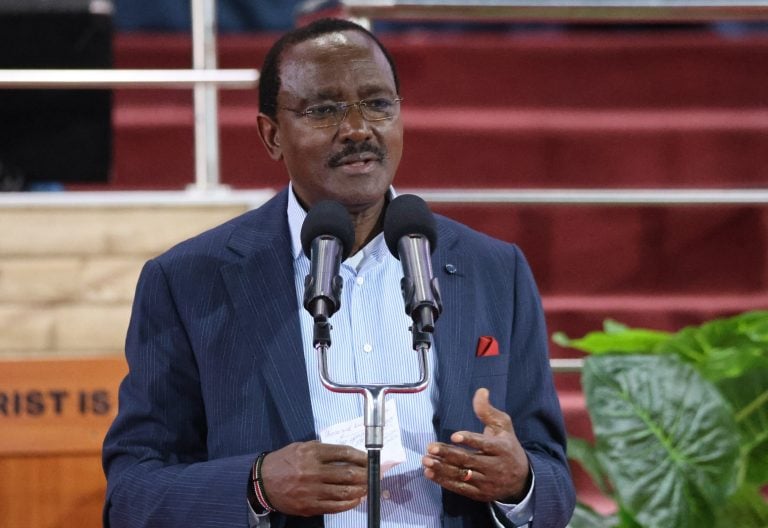
Wiper Party leader Stephen Kalonzo Musyoka has used Saba Saba Day 2026 to honour pro-democracy activists who fought for political reforms in Kenya and accuse security agencies of violating constitutional rights during recent protests.
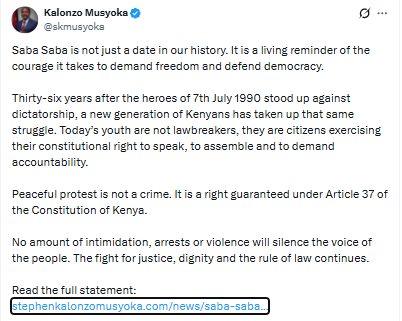
In a statement shared on his X account on Tuesday, July 7, 2026, Kalonzo said the struggles of the 1990 Saba Saba movement remain relevant as young Kenyans continue to demand accountability, justice and respect for the Constitution.
He said July 7, 1990, marked a turning point in Kenya’s political history when activists challenged the one-party system and pushed for the return of multiparty democracy.
“Thirty-six years ago today, on the 7th of July 1990, Raila Odinga, Kenneth Matiba, Masinde Muliro, Charles Rubia, Martin Shikuku, James Orengo and countless patriots defied a one-party dictatorship at Kamukunji, Nairobi,” Kalonzo stated.
You Might Also Like

He added that the activists faced arrests, detention and harassment because they demanded that Kenyans have the freedom to choose their leaders.
“Their courage and sacrifice forced the repeal of Section 2A, reopening the path to multiparty democracy,” he said.
Current calls for accountability
Kalonzo linked the historic Saba Saba struggle to the current calls by young Kenyans for accountability, saying the generation protesting today had inherited the fight for democratic freedoms.
He cited Article 37 of the Constitution of Kenya 2010, which protects the right of citizens to assemble, demonstrate, picket and present petitions to public authorities.
“The young Kenyans in our streets today, the Gen Z of this Republic, have not abandoned that struggle; they have inherited it,” Kalonzo said.
Kalonzo criticises police conduct
The Wiper leader criticised the response by security agencies during recent demonstrations, accusing police officers of using excessive force and restricting constitutional freedoms.
He claimed that peaceful protesters had faced roadblocks, heavy police deployment, and arrests by officers using unmarked vehicles.
“This is not policing. This is intimidation in service of a regime that fears its own people,” Kalonzo said.
He also raised concerns over reports of attacks against citizens, opposition leaders and independent media, arguing that political intolerance threatened Kenya’s democratic gains.
Kalonzo called for the immediate release of Kenyans arrested while taking part in peaceful demonstrations and demanded action against security officers accused of violating citizens’ rights.
“Peaceful protest is not a crime. It is a right expressly guaranteed under Article 37 of the Constitution, and no Kenyan should be detained for exercising that right,” he said.
Saba Saba recognition push
The statement came as other political leaders renewed calls for recognition of Saba Saba Day. Siaya Governor James Orengo, who was among the activists involved in Kenya’s pro-democracy movement, called for July 7 to be declared a public holiday.
Orengo said the day deserved official recognition because of its role in ending one-party rule and advancing constitutional reforms.
“Today, I led my team to the Senate in response to their summons. Once the session was adjourned, we were released, and I proceeded to Senator Edwin Sifuna’s office for a productive discussion regarding our planned ‘Linda Mwananchi’ activities,” Orengo wrote on X.
“It is time we recognise the significance of this day; Saba Saba ought to be a public holiday,” he added.
Orengo was among lawyers and activists who pushed for political reforms during the late 1980s and early 1990s. He worked alongside figures including Kenneth Matiba and other reformists who opposed the restrictions imposed under the former one-party government.
The 1990 Saba Saba protests at Kamukunji in Nairobi became a major moment in Kenya’s democracy journey. Although the rally was banned, thousands of Kenyans gathered, leading to arrests, injuries and increased pressure on the government to restore multiparty politics.
Kalonzo said the country must continue protecting the principles that inspired the movement.
He promised that if his political alliance forms the next government after the August 10, 2027 General Election, it would introduce police reforms and ensure accountability for cases involving alleged abductions and deaths in custody.
“We will build a Police Service that answers to the Constitution, not to political power,” Kalonzo said.
Author
Kenneth Mwenda
Kenneth Mwenda is a business, sports, and politics digital writer with over seven years of experience in journalism, covering breaking news, feature stories, and in-depth analysis across a range of beats.
For inquiries, he can be reached at [email protected]
View all posts by Kenneth MwendaLatest News


Advertisement
More on Inside Politics