Justina Wamae links soaring Nairobi wage bill to political-driven hirings
By Kiprono Keileb, September 18, 2025Nairobi County’s wage bill has surged dramatically over the past three years, with staff numbers more than doubling, a development that has raised concerns over the allocation of resources and stalled development projects. This is according to the former Roots Party presidential running mate Justina Wamae.
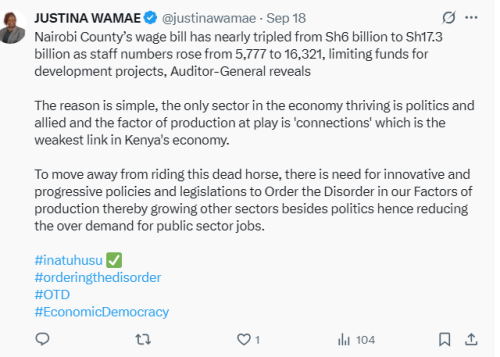
According to what Justina Wamae posted on her X account on Thursday, September 18, 2025, the county’s wage bill has ballooned from Ksh 6 billion to Ksh 17.3 billion, while the workforce expanded from 5,777 employees to 16,321. The dramatic rise, she says, has significantly limited funds for crucial development initiatives in the city.
“Nairobi County’s wage bill has nearly tripled from Sh6 billion to Ksh17.3 billion as staff numbers rose from 5,777 to 16,321, limiting funds for development projects,” Wamae noted in her statement.
Elsewhere, the Democracy for Citizens’ Party, Nairobi patron Irungu Nyakera, attributed poor leadership to tribal politics in the Nairobi governor race.
Wamae attributes this sharp increase not to economic growth or efficiency, but to politics and the influence of connections in hiring practices.
“The reason is simple, the only sector in the economy thriving is politics and allied, and the factor of production at play is ‘connections’, which is the weakest link in Kenya’s economy,” she said, highlighting what she describes as structural issues in public sector employment.
The spike in wage expenditure, she explains, underscores a broader problem with Kenya’s economic management, where politically driven hiring often overshadows the need for strategic workforce planning and resource allocation.
It is worth noting that Wamae announced her intention to contest in the 2027 elections, anchoring her campaign on economic transformation and practical solutions for citizens.
Wamae stresses that this trend not only burdens taxpayers but also undermines efforts to diversify the economy and strengthen other productive sectors.
“To move away from riding this dead horse, there is a need for innovative and progressive policies and legislations to Order the Disorder in our Factors of production thereby growing other sectors besides politics hence reducing the over demand for public sector jobs,” Wamae said, urging the government to rethink staffing strategies and promote policies that prioritize merit, efficiency, and economic growth.
As Nairobi grapples with balancing political expectations and economic realities, Wamae’s critique brings renewed attention to the urgent need for structural reforms in public sector employment, highlighting the intersection of politics and economics in shaping the city’s fiscal landscape.