Is Referendum Bill 2026 Kenya’s new path to reviving the BBI agenda?
By Aloys Michael, May 21, 2026The proposed Referendum Bill 2026 is reigniting memories of the politically divisive Building Bridges Initiative (BBI), with critics and supporters now debating whether the new law represents a genuine attempt to fix constitutional gaps or a subtle return of the controversial reform agenda through Parliament.
The Bill, currently before the Senate, seeks to create Kenya’s first standalone legal framework governing referenda, nearly five years after courts dismantled the BBI constitutional amendment process over procedural and constitutional flaws.
Key in the debate is whether the proposed law merely cures legal gaps identified by the courts or quietly lays the groundwork for future large-scale constitutional change.
The Bill openly acknowledges that recent court rulings exposed weaknesses in Kenya’s referendum framework.
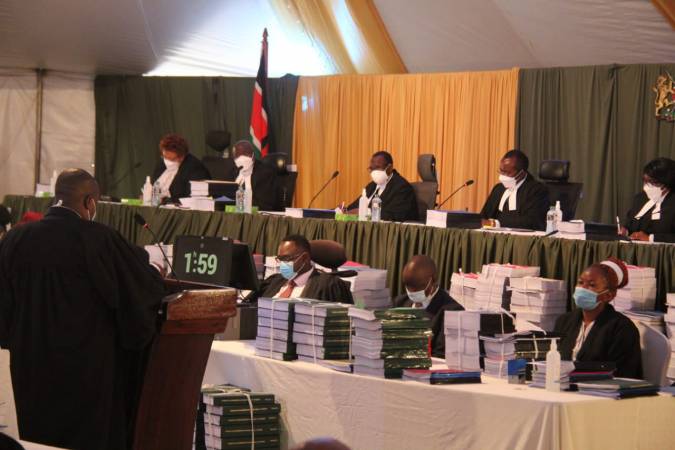
PHOTO/@Kenyajudiciary/X
The legislation seeks to consolidate the laws governing referenda and to establish clear, transparent and fair procedures for conducting referenda in a manner that reflects the will of the people,” the proposal reads in part.
The proposed law comes after the High Court, Court of Appeal and Supreme Court all faulted aspects of the BBI process, particularly the absence of a comprehensive legal structure governing referenda, signature verification and public participation.
“Courts pointed to significant gaps in Kenya’s legal framework on referenda and that the Bill seeks to address procedural gaps identified in the BBI litigation,” it states.
That admission has intensified speculation that the legislation could eventually reopen the path for constitutional amendments similar to those pursued under BBI.
The proposed framework creates a unified system for handling three categories of referenda: constitutional amendment referenda, county referenda and national referenda on major public questions.
Under the Bill, constitutional amendments touching protected areas of the Constitution, including the structure of Parliament, presidential terms and the independence of the Judiciary, would still require direct approval by voters through a referendum.

IEBC reforms?
The legislation also attempts to streamline the referendum process by setting clear timelines and responsibilities for the Independent Electoral and Boundaries Commission (IEBC).
Once Parliament passes a constitutional amendment requiring a referendum, the President would be required to notify the IEBC within 30 days, after which the commission must conduct the vote within 90 days.
The Bill further proposes detailed rules on how referendum questions should be framed, requiring them to be simple, neutral, and easy to understand in both English and Swahili.
Supporters argue that these safeguards are precisely what was missing during the BBI process.

Speaking as the Senate committee began deliberations, Senate Justice and Legal Affairs Committee chairperson Hillary Sigei said lawmakers were attempting to cure the legal fragmentation exposed during the BBI court battles.
“Our task is to cure the fragmentation the courts pointed out and give Kenyans a clear, predictable and fair process for expressing their will,” Sigei said.
One of the most politically sensitive areas in the Bill concerns popular initiatives under Article 257 of the Constitution.
The proposed law requires promoters seeking constitutional change through a popular initiative to submit signatures and identification details of at least one million registered voters, after which the IEBC must verify the signatures and make the proposal available for public inspection.

That provision mirrors one of the biggest disputes during the BBI process, where questions emerged over how signatures supporting the initiative were collected and authenticated.
Nominated Senator Crystal Asige has already warned that public trust in future referenda will depend heavily on the integrity of the verification process.
“The signatures must be open to inspection, properly verified and traceable, because without integrity at that stage the entire initiative loses legitimacy,” Asige said during committee discussions.
The Bill also introduces participation thresholds aimed at strengthening legitimacy.

For constitutional amendments to pass, at least 20 per cent of registered voters in at least half of Kenya’s counties must participate, while a simple majority must support the proposal.
Thresholds are designed to prevent sweeping constitutional changes from being driven by low voter turnout or narrow regional support.
Still, the political undertones surrounding the Bill remain unavoidable.
BBI was one of the most consequential political projects in Kenya’s recent history, championed by former President Uhuru Kenyatta and opposition leader Raila Odinga as a vehicle for constitutional restructuring and national unity.
Its eventual collapse in court reshaped Kenya’s constitutional politics and reinforced judicial scrutiny over amendment processes.
Now, by seeking to establish the very legal framework that courts said was missing during BBI, the Referendum Bill 2026 is inevitably being viewed through a political lens.
Whether the legislation becomes merely an administrative clean-up exercise or the foundation for another era of constitutional reform may ultimately depend not on the law itself, but on the political ambitions that follow once the framework is in place.