Advertisement
Inside Ruto-governor Barasa deal for national govt to manage bursaries, scholarships
Sunday 22nd February, 2026 10:14 AM|

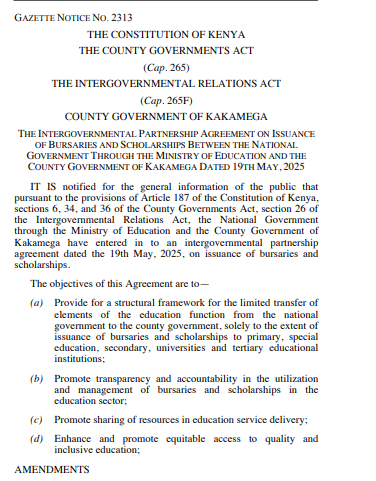
Kakamega County Government has announced that it has formed an intergovernmental partnership aimed at supporting the provision of bursaries and scholarships.
According to a gazette notice published on January 16, 2026, Governor Fernandes Barasa stated that the agreement was signed on May 19, 2025, and officially came into force on June 1, 2025.
The agreement establishes a framework that allows the national government to delegate certain aspects of its education responsibilities to the county government, exclusively for managing the issuance of bursaries and scholarships.
According to Barasa, this arrangement applies to primary, special needs, secondary, university, and other tertiary education institutions.
You Might Also Like

“It is notified for the general information of the public that pursuant to the provisions of Article 187 of the Constitution of Kenya, sections 6, 34, and 36 of the County Governments Act, section 26 of The Intergovernmental Relations Act, the National Government through the Ministry of Education and the County Government of Kakamega have entered into an intergovernmental partnership agreement,” the notice read.
“This Agreement may be amended as may be required from time to time by mutual consent of the parties. Such amendment shall be inwriting, shall come into force on the date of execution, and shall form part of this Agreement.”
The agreement aims to promote transparency and accountability in the management of bursaries and scholarships in the county, according to the governor.
The governor noted that the agreements will also promote the sharing of resources between the county and national governments in the education sector.

Devolution at stake?
The original agreements can be reviewed at the Ministry of Education headquarters, as well as at the Kakamega County Attorney’s office located within the Kakamega County Headquarters.
This announcement follows a similar move by Mombasa Governor Abdulswamad Sheriff, who confirmed the signing of a comparable agreement via a gazette notice issued on February 6, 2026, three weeks earlier.
According to the Governor, the agreement, which was signed on January 15,2026, will also provide a framework for the transfer of elements of the education functions from the national government to the county government.
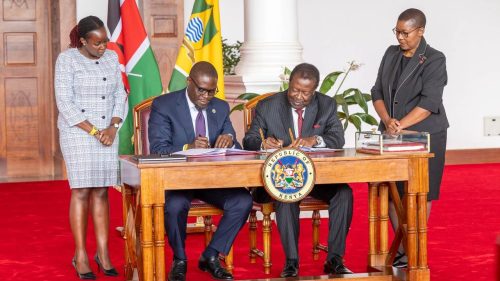
“The objective of this agreement is to promote sharing of resources in education service delivery, and enhance and promote equitable access to quality and inclusive education,” Abdullswamad said.
This comes amid concerns from a section of leaders and citizens that the intergovernmental pacts are a move to dismember devolution.
For instance, following the Nairobi governor Johnson Sakaja’s Ksh80 billion working relationship agreement with the national government, concerns have emerged over the lack of public participation and the legality of such arrangements.
Nairobi Senator Edwin Sifuna has also questioned the 14-day window provided to subject the agreement to public participation, noting that it is a very brief period and is a mere disrespect to Nairobians.
“The agreement in Clause 6.2 infact anticipates the outcome of the proposed public participation, limiting it to ‘amendments’ and forgetting that the people in their righteous might have the option of rejecting the whole arrangement in toto,” he said.

The legislator also disputed the arrangement of the steeringcommittee, citing that it is uneven since most of its members are in the national government. Prime Cabinet Secretary Musalia Mudavadi is the chair, and Nairobi Governor Johnson Sakaja is the vice chair.
He reckons that the agreement is a takeover guised under a development agreement.
“Of the 12 members of the committee, a whopping two-thirds are appointees of the national government. From its structure, the Governor will be subservient to the Prime Cabinet Secretary, making Sakaja the new Deputy Governor for all intents and purposes,” he noted.
He therefore recommended an alternative model to achieve development in Nairobi, including the clearing of all debts owed by the National Government agencies, which are in excess of Ksh100 billion, and allowing the County Assembly to reinvest the money in county projects and payment of pending bills.
Author
Latest News



Advertisement
More on Inside Politics