Advertisement
Finance Bill 2026: Gachagua rallies MPs to reject controversial tax proposals
Thursday 18th June, 2026 12:08 PM|
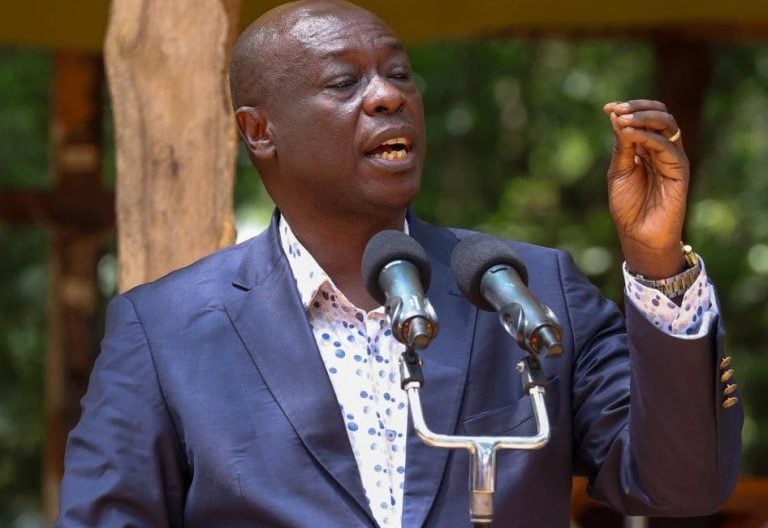
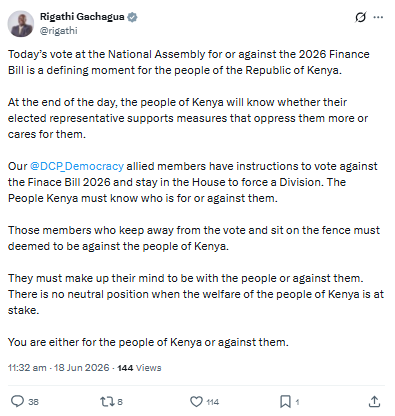
Former Deputy President Rigathi Gachagua has intensified pressure on Members of Parliament ahead of the crucial vote on the Finance Bill 2026, describing the debate as a defining political moment for Kenya.
In a statement posted on his official X account on Thursday, June 18, 2026, Gachagua urged MPs allied to his Democracy for Citizens Party (DCP) to reject the bill and remain in the National Assembly during voting to force a formal division vote.
“Today’s vote at the National Assembly for or against the 2026 Finance Bill is a defining moment for the people of the Republic of Kenya,” Gachagua stated.
“At the end of the day, the people of Kenya will know whether their elected representative supports measures that oppress them more or cares for them.”
You Might Also Like

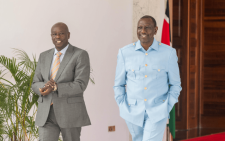
The Finance Bill 2026 has triggered intense political debate across the country, with supporters describing it as a reform-driven law aimed at improving tax administration, while critics argue that it introduces hidden taxes that will increase the cost of living.
Gachagua accused MPs who avoid voting of failing Kenyans.
“Those members who keep away from the vote and sit on the fence must be deemed to be against the people of Kenya,” he said.
“They must make up their mind to be with the people or against them. There is no neutral position when the welfare of the people of Kenya is at stake.”
Tax debate intensifies
The statement came as Parliament prepared for further debate and voting on the Finance Bill 2026, which has already passed Second Reading amid heated exchanges between government and opposition lawmakers.
The bill has revived memories of the 2024 anti-tax protests that rocked the country and forced President William Ruto’s administration to withdraw the Finance Bill 2024 after widespread demonstrations led largely by Gen Z activists.
Several opposition leaders, including Gachagua and Wiper leader Kalonzo Musyoka, have linked the current debate to the anniversary of those protests, which will be marked on June 25.
A major point of contention in the Finance Bill 2026 has been taxation on everyday goods and sectors that affect ordinary Kenyans.
Opposition MPs have raised concerns over proposals affecting mitumba imports, rental income taxation, mobile phone imports, and expanded powers for the Kenya Revenue Authority (KRA).
Kathiani MP Robert Mbui strongly opposed the bill during debate in the National Assembly.
“I rise to oppose this draconian, punitive, knee-on-the-neck-of-Kenyans Finance Bill 2026,” Mbui said.
Mbui criticised proposals that would allow KRA to use third-party data to determine tax liabilities. He argued that such measures could unfairly target businesses.
He also questioned why President Ruto’s promise to exempt workers earning below Ksh30,000 from PAYE had not been included in the bill.
Kiharu MP Ndindi Nyoro also accused the government of making promises that were not reflected in legislation.
“We have seen the Head of State talking about the exemption of PAYE for Kenyans earning below Ksh30,000; that has not been captured here,” Nyoro said during debate.
Another controversial issue has involved mitumba imports. Critics argue that changing second-hand clothes from zero-rated VAT status to tax-exempt status could increase prices because traders would no longer claim input VAT.
Bumula MP Wanami Wamboka warned that the changes would silently increase the cost of living.
“My single biggest problem with this Bill is that it hides price increases inside technical tax language,” he said.
MPs face pressure
Kiambu Senator Karungo wa Thang’wa has also called for major amendments or outright rejection of the bill, warning that some proposals could hurt local manufacturing and destroy jobs.
“This bill should have been a jobs bill. It should have been an industrial bill. It should have been a youth livelihoods bill,” Thang’wa said.
“But as currently drafted, it is a job-destroyer bill.”
Thang’wa argued that local mobile phone assemblers and electric mobility firms could suffer because imported finished products may become cheaper than locally assembled goods.
He warned that factories could close if local manufacturers continue facing higher taxes on components and production inputs.
“A country cannot import its way into industrialisation,” the senator said.
Government leaders, however, have defended the Finance Bill 2026 and accused critics of spreading misinformation.
Majority Leader Kimani Ichung’wah insisted that the bill does not introduce harmful taxation measures.
“This Bill is not imposing any taxation that may be harmful to Kenyans,” Ichung’wah said in Parliament.
Finance Committee Chairperson Kuria Kimani also rejected claims that the bill imposes new taxes on mitumba traders and mobile phone users.
According to the Finance Committee, Parliament received more than 100,000 submissions during public participation conducted across 13 counties.
Author
Kenneth Mwenda
Kenneth Mwenda is a business, sports, and politics digital writer with over seven years of experience in journalism, covering breaking news, feature stories, and in-depth analysis across a range of beats.
For inquiries, he can be reached at [email protected]
View all posts by Kenneth MwendaLatest News



Advertisement
More on Inside Politics