DCP’s Kamau Ngotho urges Ol Kalou voters outside constituency to contact him before poll
By David Nthua, July 14, 2026Democracy for the Citizens Party candidate Samuel Kamau Ngotho has launched a final push to mobilise registered Ol Kalou voters who are outside the constituency ahead of Thursday’s parliamentary by-election.
Using Facebook on Tuesday, July 14, 2026, Ngotho asked affected voters to contact him privately and provide their current locations and the polling stations where they are registered.
“Good morning, my people. It’s barely two days to the D-Day,” Ngotho said.
“I understand some of our registered voters in Ol Kalou are currently out of the constituency or far from their polling stations.
If that’s you, kindly inbox me with your locality and the polling station where you are registered to vote. We will work it out accordingly.”
He concluded the message by declaring: “Let’s make every vote count.”

Ngotho did not specify the form of assistance his team intended to offer. His statement did not expressly mention transport, money or any other material benefit.
Ngotho targets decisive Ol Kalou voter bloc
The appeal signals that Ngotho’s DCP campaign has shifted from public rallies to last-mile voter mobilisation as the race enters its final hours.
Ol Kalou has 73,480 registered voters spread across 144 polling stations in Karau, Kanjuiri Ridge, Mirangine, Kaimbaga and Rurii wards.
Rurii has 33 polling stations, Kanjuiri Ridge has 32, while Karau and Kaimbaga have 27 each. Mirangine has 25 polling stations.
The votes will be tallied at Ol Kalou Secondary School Hall after polling closes on Thursday.
For Ngotho, reaching voters who are away from their polling stations could be critical in a contest where a few thousand votes may determine the winner.

The DCP candidate has direct experience of how a relatively small mobilisation gap can decide the Ol Kalou parliamentary seat.
How 4,679 votes denied Ngotho victory in 2022
During the August 2022 General Election, Ol Kalou had 72,997 registered voters.
David Njuguna Kiaraho successfully defended the parliamentary seat on a Jubilee Party ticket after receiving 24,058 votes.
Ngotho, who was then the United Democratic Alliance candidate, finished second with 19,380 votes.
The difference between the two candidates was 4,678 votes. Ngotho would therefore have required at least 4,679 additional votes to move ahead of Kiaraho, assuming the winner’s tally remained unchanged.
Those 4,679 votes represented only about 6.4 per cent of the constituency’s registered voters in 2022.
The two leading candidates received a combined 43,438 votes, equivalent to about 59.5 per cent of the entire registered electorate.

That left 29,559 registered voters outside the combined tallies of Kiaraho and Ngotho.
However, that figure should not be treated entirely as the number of people who abstained.
It also includes voters who supported the other four parliamentary candidates, voters who did not participate in the parliamentary election and any rejected ballots.
The arithmetic nevertheless demonstrates the size of the electoral bloc that was not captured by the two leading candidates.
Ngotho’s appeal to voters outside Ol Kalou is therefore a calculated attempt to prevent distance from polling stations from costing him votes in another closely fought election.
Ol Kalou voter register increases
The constituency’s voter register has grown from 72,997 voters in 2022 to 73,480 voters for the July 16, 2026, by-election.
That is an increase of 483 voters, representing a growth of approximately 0.7 per cent.
Although the increase is relatively small, the 2022 margin shows that mobilisation of even a fraction of the registered electorate could affect the final result.
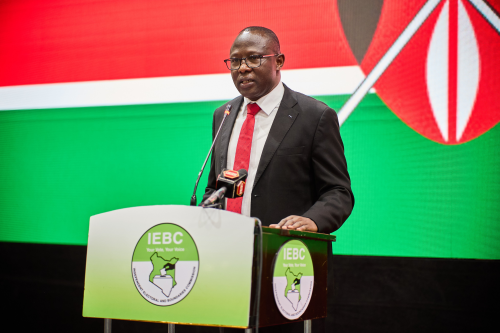
The by-election was triggered by Kiaraho’s death on March 29, 2026. He had represented Ol Kalou since 2013 and was serving his third term in the National Assembly.
Ngotho returns on DCP ticket
Ngotho enters the by-election with an established political network after his strong performance against Kiaraho in 2022.
However, he is returning on a different political vehicle.
In 2022, he secured his 19,380 votes as the UDA candidate. He is now challenging the ruling party as the DCP flagbearer, turning his previous support base into a major battleground between the two parties.
Ngotho won the DCP nomination after collecting 12,957 votes. His closest challenger, Paul Waiganjo, received 4,978 votes.
UDA has fielded Samuel Muchina Nyagah, a former aide to Kiaraho.
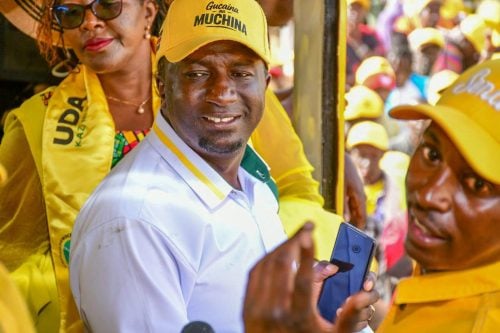
Muchina secured the ruling party ticket with 3,221 votes, narrowly defeating George Wambugu Kanuri, who received 3,077 votes. Approximately 8,000 voters participated in the UDA nomination exercise.
The DCP and UDA nomination figures came from separate party exercises conducted under different conditions and cannot be directly used to predict the by-election outcome.
They nevertheless illustrate the different mobilisation challenges facing both candidates.
DCP must convert the enthusiasm witnessed during its nominations into votes in the official election, while UDA must rally its broader membership after a closely contested primary.
Ruto and Gachagua flex political muscles
The Ol Kalou by-election has developed into more than a contest to replace Kiaraho.
It is widely viewed as a political test between President William Ruto’s UDA and former Deputy President Rigathi Gachagua’s DCP ahead of the 2027 General Election.
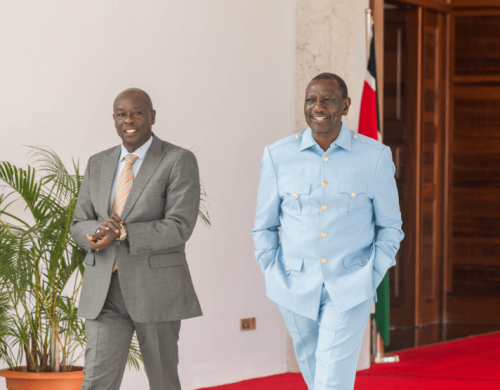
UDA is seeking to demonstrate that it retains control of the Mt Kenya electorate despite growing political competition from Gachagua.
DCP, on the other hand, is treating Ol Kalou as an opportunity to prove that political support in Nyandarua and the wider Mt Kenya region has shifted away from the ruling party.
Ngotho presents a particular challenge to UDA because the votes he received in 2022 were mobilised under the ruling party’s banner.
The July 16 election will consequently test whether those voters were loyal to Ngotho as an individual or to UDA as a political organisation.
It will also test whether DCP can translate large campaign crowds, party nomination participation and anti-government sentiment into actual votes at polling stations.