Alai pushes for Nairobi–Kiambu merger, restructuring of Mt Kenya counties
By Kiprono Keileb, August 29, 2025Kileleshwa ward MCA Robert Alai has ignited fresh debate on county governance, calling for a radical restructuring of the Mount Kenya region that would see key counties merged for stronger economic and administrative efficiency.
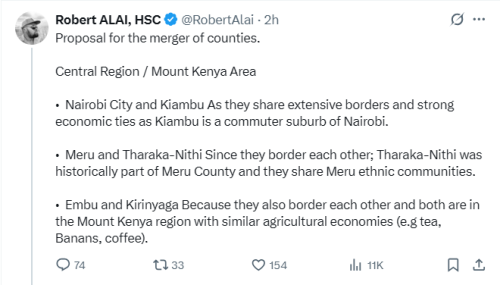
In a statement shared on his official X account on Friday, August 29, 2025, Alai argued that countries with common borders, shared communities, and linked economies should not remain fragmented. He singled out Nairobi and Kiambu as prime candidates for merger, citing their interconnectedness.
“Nairobi City and Kiambu should merge as they share extensive borders and strong economic ties, with Kiambu serving as a commuter suburb of Nairobi,” Alai wrote.
The MCA further pushed for the unification of Meru and Tharaka-Nithi counties. He reminded Kenyans that Tharaka-Nithi was historically part of Meru before the creation of devolved units.
“Since they border each other and share Meru ethnic communities, there is no reason for them to remain separate,” he stated.
Alai also weighed in on Embu and Kirinyaga, saying the two counties have similar agricultural economies and face the same development challenges. “Embu and Kirinyaga also border each other and are in the Mount Kenya region with economies built on tea, bananas, and coffee. They should work as one,” he said.
His proposal comes at a time when debates around the sustainability of Kenya’s 47 counties continue to dominate political and public discourse. Critics of devolution argue that the system has become bloated with administrative costs, while supporters insist that counties guarantee grassroots service delivery.
By calling for mergers, Alai has reignited questions on whether fewer, stronger counties could boost efficiency and reduce wastage. While his proposal may attract political resistance, it taps into a growing conversation on the future of devolution and whether the current county structure serves citizens effectively.
Alai’s bold stance is expected to spark wider debate, particularly within the Mount Kenya region, where questions of identity, resources, and political influence remain sensitive.
“The future of devolution is not in multiplying inefficiencies but in restructuring for growth,” he concluded.