Advertisement
Yields on Kenya’s Eurobonds decline as secondary bond market cools
Thursday 25th December, 2025 08:11 PM|

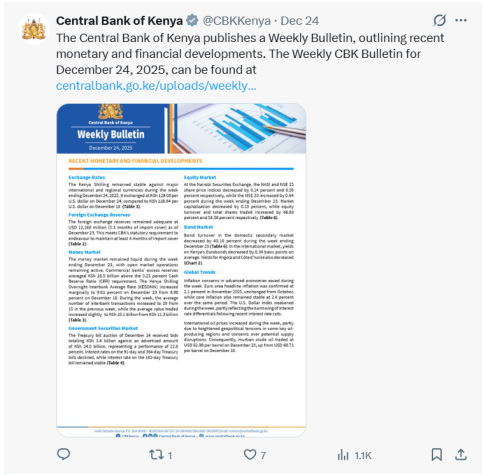
Yields on Kenya’s Eurobonds fell during the week ending December 23, 2025, offering some relief in the international debt market, according to the Central Bank of Kenya’s weekly bulletin released on December 24.
The CBK reported an average decrease of 8.34 basis points in yields on Kenya’s Eurobonds.
“Bond turnover in the domestic secondary market decreased by 40.18 per cent during the week ending December 23 (Table 6). In the international market, yields on Kenya’s Eurobonds decreased by 8.34 basis points on average. Yields for Angola and Côte d’Ivoire also decreased,” the bulletin noted, adding that similar declines were observed for Angola and Côte d’Ivoire.
The positive movement in the international market contrasted with a sharp slowdown in domestic secondary bond trading, where turnover dropped by 40.18 per cent during the week.
You Might Also Like



Investors in the global market appeared to respond favourably to lower borrowing costs, while domestic activity slowed amid seasonal and market-specific factors.
Mixed Equity market performance
At the Nairobi Securities Exchange, equity markets recorded mixed performance during the same period. The NASI and NSE 25 indices declined by 0.14 per cent and 0.59 per cent, respectively, while the NSE 20 rose by 0.64 per cent. Equity turnover surged by 66.80 per cent, indicating heightened trading activity despite dips in some key indices.
The Government Securities Yield Curve, as depicted in the CBK bulletin, showed evolving borrowing costs, with recent trends reflecting adjustments across different maturities.
In the domestic debt landscape, gross domestic debt edged higher, influenced by changes in Treasury holdings and overdrafts. Financial corporations continued to dominate government securities ownership, holding 78.9 per cent as of mid-December.
Global influences and external pressures
The CBK bulletin highlighted broader global influences on Kenya’s debt market. “The U.S. Dollar Index weakened during the week, partly reflecting the narrowing of interest rate differentials following recent interest rate cuts,” it noted.
Additionally, rising oil prices amid geopolitical risks contributed to external pressures, with Murban crude climbing to USD 62.90 per barrel on December 23.
These developments suggest improving sentiment toward Kenyan debt in international markets, even as domestic secondary bond activity moderated.
Author
Latest News







Advertisement
More on Business