Advertisement
World Bank warns Kenya’s growth faces threat from mounting debt, fiscal pressure
Tuesday 25th November, 2025 09:21 AM|

The World Bank for Africa has raised fresh concerns over Kenya’s rising fiscal pressures, warning that despite signs of economic recovery, mounting debt and widening deficits could stall the country’s growth momentum. The institution’s latest economic update paints a picture of a country moving forward but weighed down by structural weaknesses that continue to threaten long-term stability.
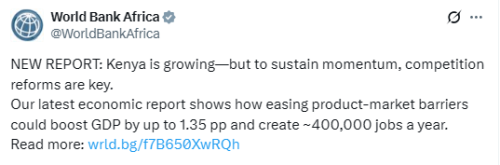
Speaking through an X post posted on Tuesday, November 25, 2025, the World Bank said Kenya’s economy is expected to grow by an average of 4.9 per cent between 2025 and 2027, an improvement from earlier projections. The update shows that Kenya is benefiting from easing monetary conditions, stronger private sector credit, and a rebound in key sectors such as construction. “Inflation remains within target, a stable exchange rate, and foreign exchange reserves at record highs,” the statement reads. The Bank noted that private sector credit grew five per cent year-on-year by September 2025, supported by lower lending rates and accommodative policies.
Kenya’s weakening fiscal position
But behind the renewed economic optimism lies a growing worry: Kenya’s weakening fiscal position. The World Bank warned that the FY2024/25 fiscal deficit had widened to 5.9 per cent of GDP, far above the initial 4.3 per cent target, mainly due to revenue shortfalls and rigid expenditure patterns. “Fiscal pressures are intensifying, with the FY2024/25 deficit widening to 5.9% of GDP, above the original 4.3% target, driven mostly by revenue shortfalls and increasingly rigid expenditure structures. Risks of fiscal slippage persist,” the statement reads. The institution also pointed out that public debt reached 68.8 per cent of GDP during the fiscal year, pushing the country deeper into a high-risk category of debt distress.
The Bank’s Division Director for Kenya, Rwanda, Somalia, and Uganda, Qimiao Fan, emphasised that Kenya could unlock even more growth if it tackles long-standing barriers to competition.
You Might Also Like



“Economic growth momentum could be further sustained by addressing key barriers to competition, more and better-paying jobs, and lower prices to consumers,” he noted
The warning was echoed by Jorge Tudela Pye, the World Bank’s Country Economist for Kenya, who explained that while Kenya’s macroeconomic indicators look strong, the underlying fiscal situation cannot be ignored. “Many key macroeconomic indicators continue to show strength; however, the fiscal outlook remains subject to downside risks that could threaten sustained and inclusive economic growth,” he said
labour market strains
The report also highlighted Kenya’s persistent labour market strains, noting that formal employment stands at just 15 per cent and real wages continue to fall. The Bank attributes these weaknesses to deep structural issues that limit productivity and job creation.
In its analysis titled From Barriers to Bridges: Procompetitive Reforms for Productivity and Jobs in Kenya, the World Bank stressed the urgency of reforms that would boost competition across sectors.
Kenya’s Product Market Regulation score of 2.92, higher than peer economies, shows the heavy restrictions that still hinder business activity. The Bank recommends reducing exchequer transfers to commercial state-owned enterprises and adopting performance-based systems for public service obligations to level the playing field.
Sector-specific proposals include opening up electricity transmission and distribution to private investment, strengthening telecommunications regulation, and ensuring fairer distribution of fertiliser subsidies. According to the Bank, these reforms could increase Kenya’s GDP growth by up to 1.35 percentage points and raise labour compensation growth by two percentage points, creating the equivalent of 400,000 jobs annually.
The message is clear: Kenya is on a promising path, but without bold fiscal discipline and structural reforms, its growth story could quickly lose momentum.
Author
Latest News







Advertisement
More on Business