World Bank backs push to cut Africa’s reliance on imported medicines
By Faith Lagat, April 5, 2026The World Bank Group is backing Africa’s drive to reduce its dependence on imported medicines, a move that complements Kenya’s efforts to build local pharmaceutical capacity and health sovereignty.
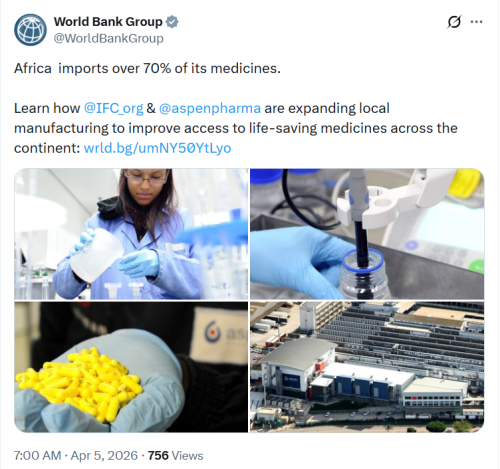
The continent faces a stark paradox: it bears about a quarter of the global disease burden yet imports over 70 per cent of its medicines. This reliance exposes millions, including diabetic patients in South Africa, mothers seeking vaccines in Nigeria, and elderly Kenyans needing antibiotics, to shortages, inflated prices, and supply chain disruptions that hit low- and middle-income families hardest.
Through the Africa Centres for Disease Control and Prevention, leaders have set an ambitious target of vaccine sovereignty by 2040, aiming for local production to meet up to 60 per cent or more of the continent’s vaccine needs.
Ken Osei, Principal Investment Officer at IFC, said, “Even essential medicines were being imported into Africa, and during the pandemic, that was a big limitation. The theme of ‘manufacturing in Africa for Africa’ is extremely important.”
For Kenya, building local capacity could save foreign exchange, create jobs, and enhance health security.
The World Bank’s private sector arm, IFC, is supporting this through innovative financing and partnerships. IFC’s collaboration with Aspen Pharmacare, Africa’s largest pharmaceutical company, includes Ksh165 billion in long-term syndicated financing across two facilities: Ksh90 billion in 2021 to strengthen vaccine supply chains during the COVID-19 crisis, and another package in 2024, which includes Ksh75 billion with partners such as Proparco, DEG, and DFC to expand access to essential medicines.
Kenya sets targets for local production
Kenya imports about 70 per cent of its medicines, with a market valued at roughly Ksh76 billion.
Local manufacturers supply only 30 per cent of demand, while over 85 per cent of essential medicines are not produced locally, straining foreign exchange reserves and exposing the country to global disruptions.
The government has set clear targets, aiming for at least 50 per cent of medicines on the Kenya Essential Medicines List to be produced locally by the end of 2026, with broader self-sufficiency envisioned by 2028.
On Monday, January 12, 2026, the Kenya Investment Authority hosted a Pharmaceutical Sector Roundtable in Nairobi, bringing together the Ministry of Health, IFC, Manufacturing Africa, Vision 2030 Delivery Secretariat, Kenya Development Corporation, and the Kenya Association of Manufacturers.
Stakeholders emphasised the need for investment incentives, regulatory reforms, access to finance, and skills development to close the demand-supply gap. Progress is also accelerating on vaccines, with Health Cabinet Secretary Aden Duale confirming the second phase at the Kenya BioVax Institute, focusing on systems integration and fill-and-finish technology.
The facility is expected to produce locally manufactured vaccines, insulin, snake anti-venoms, biosimilar anti-cancer drugs, and medical infusions by the end of 2027.
Integrating herbal medicine and addressing barriers
Kenya is also integrating traditional herbal medicine into its pharmaceutical plans. Elgeyo-Marakwet County has emerged as a hub in partnership with the Kenya Medical Research Institute, documenting over 140 medicinal plant species, with six prioritised for cancer treatment studies.
Pilot testing in referral hospitals is set to start in July 2026, complemented by clinical trials at Iten County Referral Hospital. Governor Wisley Rotich said the initiative could validate indigenous knowledge, improve rural access, and create economic opportunities through farmer training.
Barriers such as fragmented markets, counterfeit drugs, skills shortages, weak regulations, and limited long-term financing remain. However, partnerships like IFC-Aspen demonstrate how funding and technical support can strengthen supply chains.