Willis Otieno criticises govt’s fiscal plans for 2026/27 financial year
By Joel Masibo, January 6, 2026City lawyer and political analyst Willis Otieno has criticised the government’s fiscal plans for the 2026/27 financial year, warning that Kenya is sliding into dangerous economic territory marked by poor discipline and questionable intent.
Taking to X on Tuesday, January 6, 2026, Otieno reacted to plans by the State to borrow up to Ksh1 trillion in the 2026/27 financial year while at the same time moving to sell off public assets.
According to him, the two actions are fundamentally contradictory and signal deeper problems in the management of public finances.

Debt addiction
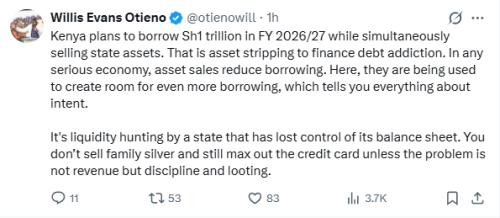
”Kenya plans to borrow Ksh1 trillion in FY 2026/27 while simultaneously selling state assets. That is asset stripping to finance debt addiction,” Otieno said in part.
In well-run economies, he argues, proceeds from the sale of state assets are ordinarily used to reduce borrowing or pay down existing debt. Kenya’s approach, however, appears to be doing the opposite.
He describes the strategy as asset stripping meant to sustain what he terms a growing “debt addiction.”
”Here, they are being used to create room for even more borrowing, which tells you everything about intent,” Otieno said.
Rather than easing pressure on the national balance sheet, asset sales are being used to create fiscal space for even more borrowing. For Otieno, this reveals troubling intent and raises concerns about whether the government is genuinely committed to restoring fiscal stability.
Otieno further characterises the situation as “liquidity hunting” by a state that has effectively lost control of its balance sheet. In his view, the challenge facing the country is not a shortage of revenue, but a lack of discipline in how public resources are managed. He suggests that selling valuable public assets while continuing to pile on debt mirrors a household that sells its prized possessions yet continues to max out its credit cards.
Mismanagement and looting
Such a pattern, Otieno warns, points to deeper issues of waste, mismanagement and looting rather than sound economic planning. The risk, he says, is that Kenya could be left poorer in assets while still heavily burdened by debt, passing the cost of today’s decisions to future generations.
”It’s liquidity hunting by a state that has lost control of its balance sheet. You don’t sell family silver and still max out the credit card unless the problem is not revenue but discipline and looting.” Willis Otieno added.
His remarks add to the growing public debate over rising debt levels, proposed privatisation of state-owned enterprises and the sustainability of government borrowing.