Why Kenya’s new Competition Bill could change how Bolt, Uber and digital platforms operate
By Aloys Michael, July 24, 2026Bolt, Uber, Glovo and other digital platforms could soon face tougher regulatory scrutiny in Kenya under sweeping competition law reforms that shift attention from traditional market dominance to the growing power of digital platforms.
The proposed Competition (Amendment) Bill, 2026 seeks to modernise Kenya’s competition laws by giving the Competition Authority of Kenya (CAK) new tools to regulate digital markets, including ride-hailing apps, online marketplaces, app stores, search engines and social media platforms.
The Bill’s memorandum leaves little doubt about its objective. It says the amendments are intended “to broaden the mandate of the Competition Authority in addressing anti-competitive conduct in digital markets and unfair market conduct arising from the abuse of superior bargaining position.”
For companies such as Bolt and Uber, whose businesses depend on connecting millions of passengers with independent drivers through digital platforms, the proposed law could usher in a new era of regulatory oversight.
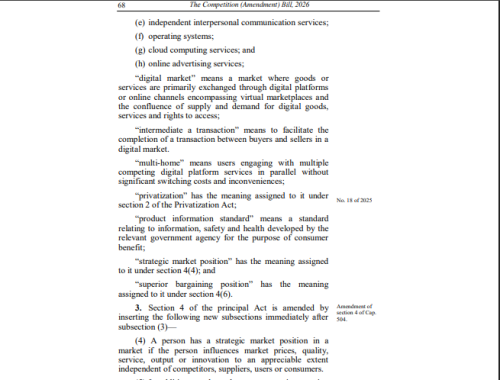
Unlike the current law, which largely focuses on whether a company is dominant in a market, the Bill introduces the concept of “strategic market position.” This means the Competition Authority would also consider whether a digital platform can significantly influence prices, service quality, innovation or market conditions even if it does not hold a dominant market share.
To determine whether a company holds such a position, regulators would examine factors including network effects, access to competition-relevant data, economies of scale, switching costs, multi-homing by users and the importance of the platform as an intermediary between businesses and consumers.
These criteria closely reflect how competition authorities around the world increasingly assess the market power of digital platforms.
Why Bolt and Uber could face closer scrutiny
The Bill specifically recognises businesses that intermediate transactions in digital markets, a description that fits ride-hailing platforms, which connect passengers and drivers through their applications. It also provides that, in digital markets, an undertaking controlling less than 40 per cent market share may still possess market power if it holds a significant strategic position.
For Bolt, this could mean regulators pay greater attention not only to its market share, but also to how much influence it has over drivers, pricing, customer data and the overall ride-hailing ecosystem.
Another major change is the introduction of a new prohibition against abuse of superior bargaining position, significantly expanding the Competition Authority‘s enforcement powers.

The Bill defines superior bargaining position as a situation where one party creates “an imbalance in the rights and obligations” in its commercial relationship and where the other party lacks “a viable and satisfactory alternative in the market.” Importantly, regulators would not have to prove that the company is dominant before investigating such conduct.
That provision could become particularly relevant for digital platforms whose business models depend on large networks of independent drivers, merchants or sellers.
The proposed legislation identifies several practices that could amount to abuse, including unilaterally changing contract terms without notice, imposing unfair trading conditions, transferring commercial risks to counterparties, demanding preferential treatment, charging service fees above competitive levels, unreasonably collecting or processing counterparties’ data and making it unnecessarily difficult to terminate commercial relationships.
While the Bill does not single out any company, these provisions could reshape how digital platforms structure contracts and manage relationships with drivers, delivery riders, merchants and other business users.
Why the bill matters
The proposed reforms represent a significant shift in Kenya’s competition policy. Instead of focusing primarily on whether a company is the biggest player in a market, regulators would increasingly examine how digital platforms derive influence through data, technology, network effects and their role as indispensable intermediaries.
The Competition Authority would also gain stronger enforcement powers, including the ability to issue written warnings, order companies to remedy anti-competitive conduct, impose reporting obligations and levy administrative penalties of up to 10 per cent of an undertaking’s gross annual turnover in Kenya during the preceding financial year, subject to due process.
If Parliament passes the Competition (Amendment) Bill, 2026, Kenya will join a growing number of jurisdictions updating competition laws for the digital economy.
For ride-hailing firms such as Bolt and Uber, as well as online marketplaces, app stores and other technology platforms, success will increasingly be measured not only by market share but also by how they exercise their influence over the businesses and consumers that depend on them.