Why Kenya’s deepening reliance on China risks the economy – Study
By Aloys Michael, May 3, 2026Kenya’s economic ties with China are growing stronger, but the balance is increasingly one-sided.
A new economic outlook for 2026 by LEAF Africa, the report shows that China now accounts for about 20.8 per cent of Kenya’s imports, making it the country’s largest source of goods.
In contrast, Kenya’s exports to China remain below 3 per cent, exposing a widening trade imbalance.
This gap is raising concerns about long-term economic vulnerability.
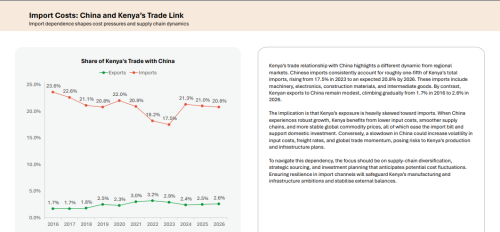
“The implication is that Kenya’s exposure is heavily skewed toward imports,” the report states, indicating a structural dependency that could shape the country’s future.
China supplies Kenya with critical goods, machinery, electronics, construction materials, and industrial inputs. These imports support infrastructure projects, manufacturing, and everyday consumption.
“In good times, this relationship works in Kenya’s favour by lowering input costs, smoother supply chains and more stable global commodity prices,” the report notes.
Overdependence crisis?
However, the risks are becoming more visible; if China’s economy slows down, Kenya could face higher import costs, supply chain disruptions, and increased pressure on local industries. This could affect everything from construction projects to manufacturing output.
The dependency also limits Kenya’s ability to grow its own industrial base. Local manufacturers often struggle to compete with cheaper imported goods, contributing to the decline in the manufacturing sector, which has fallen to about 7.2 per cent of GDP.

At the same time, the country’s overall trade balance remains negative, driven largely by high import demand. The deficit is projected at around Ksh1.6 trillion in 2026, reflecting continued reliance on foreign goods.
This imbalance is not just about trade; it is about economic resilience.
LEAF Africa says heavy reliance on a single partner exposes Kenya to external shocks beyond its control. Changes in global markets, geopolitical tensions, or policy shifts in China could quickly ripple through the Kenyan economy.
“Managing this risk will require deliberate action such as supply-chain diversification, strategic sourcing, and investment planning to reduce exposure,” the report warns.
“Diversifying import sources could help cushion the economy against disruptions, while boosting local production could reduce reliance on imports over time.”

It also says there is a need to increase exports to China. Currently, Kenya sells mainly raw or low-value goods, limiting its earnings potential. Expanding into value-added products could help narrow the trade gap.
“At a broader level, the issue reflects a deeper structural challenge. Kenya’s economy remains import-heavy, with growth driven more by consumption and infrastructure than by industrial production.”
This, the study says, raises a critical question: can Kenya sustain growth while relying so heavily on imports?
The report suggests that without changes, the imbalance could persist and even deepen.
For now, China remains a key partner in Kenya’s economic story. But as the numbers show, the relationship is uneven, and managing that imbalance may be one of the country’s biggest economic tests in the years ahead.