Treasury gives nod on Nairobi–Nakuru–Mau Summit project
By Kiprono Keileb, October 28, 2025The government has approved the construction of the Nairobi–Nakuru–Mau Summit and Nairobi–Maai Mahiu (A8 South) roads under a Public–Private Partnership (PPP) model, paving the way for one of the largest infrastructure investments on Kenya’s northern corridor.
Also Watch: Nyoro opposes toll charges on Rironi–Mau summit road.
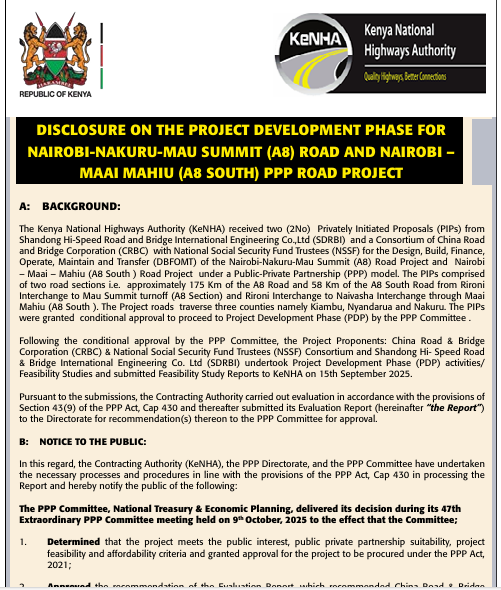
In a public notice issued on Tuesday, October 28, 2025, on MyGov weekly, the Kenya National Highways Authority (KeNHA) announced that the PPP Committee of the National Treasury and Economic Planning had approved the evaluation of the two projects after a detailed review of feasibility studies.
“The PPP Committee determined that the project meets the public interest, public–private partnership suitability, project feasibility and affordability criteria and approved the project to be procured under the PPP Act, 2021,” the authority said.
The approval follows proposals submitted by two consortia: China Road & Bridge Corporation (CRBC) in partnership with the National Social Security Fund (NSSF), and Shandong Hi-Speed Road and Bridge International Engineering Co., Ltd (SDRBI).
According to KeNHA, the project will cover 175 kilometres of the Nairobi–Nakuru–Mau Summit (A8) section and 58 kilometres of the Nairobi–Maai Mahiu (A8 South) road, cutting across Kiambu, Nyandarua and Nakuru counties.
What the approval means for motorists
The project, designed under a Design, Build, Finance, Operate, Maintain, and Transfer (DBFOMT) model, means the private contractors will construct and operate the roads before transferring ownership back to the government after a set concession period.
KeNHA said the move was part of efforts to facilitate transport. “KeNHA remains committed to strictly adhering to the provisions of the PPP Act, Cap 430 and further assures the public that it will endeavour to abide by the provisions of the PPP Act, Cap 430,” the statement reads.
Once completed, the dual carriageway is expected to ease traffic congestion along one of the busiest trade and transport routes in the country, connecting Nairobi to western Kenya and neighbouring countries such as Uganda, Rwanda, and South Sudan.
Concerns over toll payments
However, the approval has reignited debate among Kenyans over toll charges per kilometre, a system expected to be introduced once the road is operational.
Critics argue that tolling may make travel expensive for ordinary motorists and long-distance transporters, especially given the rising cost of fuel and inflation.
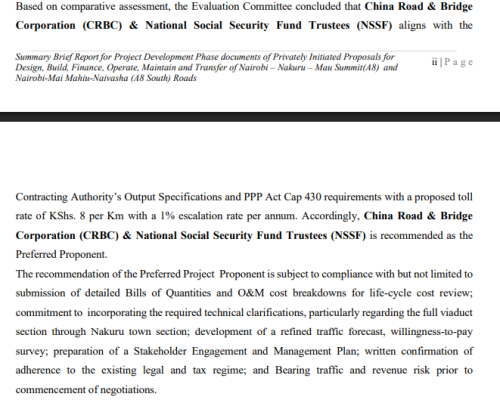
The Kenya National Highways Authority (KeNHA) has released a detailed report confirming that motorists using the Nairobi–Nakuru–Mau Summit Road will pay a toll rate of Ksh 8 per kilometre, with an annual escalation rate of 1 per cent, once the project is completed.
According to the report published on KeNHA’s official website on October 22, 2025, the proposed tolling model emerged from the evaluation of a Privately Initiated Proposal (PIP) submitted by China Road and Bridge Corporation (CRBC) in partnership with the National Social Security Fund (NSSF).
KeNHA, however, maintains that such projects are necessary to ensure the sustainability of road maintenance and to attract private investment in large-scale infrastructure.
“The Government of Kenya remains committed to delivering critical infrastructure to Kenyans,” the notice said, assuring that all legal and social safeguards outlined in the evaluation report will be fulfilled before implementation begins.
The authority has invited members of the public to submit feedback through its official website or visit any of its regional offices for clarification.
The announcement marks a significant step toward transforming the country’s main transport arteries, but also renews the public’s demand for affordable, transparent, and inclusive infrastructure development.