Advertisement
Treasury bill rates dip as CBK seeks growth amid uncertainty fears
Saturday 27th September, 2025 02:03 PM|

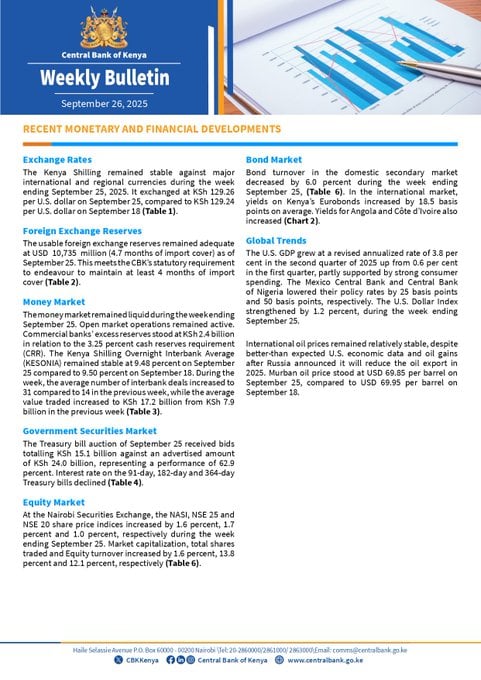
The Central Bank of Kenya (CBK) has reported a decline in Treasury bill interest rates across all tenors, signalling an effort to stimulate borrowing and investment in a challenging global environment.
According to the latest Weekly Bulletin released on September 26, 2025, the 91-day, 182-day and 364-day Treasury bills recorded rates of 7.914 per cent, 7.985 per cent and 9.533 per cent, respectively.
The downward movement, highlighted in the report, followed a Treasury bill auction on September 25 that attracted bids amounting to Ksh15.1 billion against an advertised Ksh24.0 billion, translating to a performance rate of 62.9 per cent.
Also watch: Kang’ata, Wambua urge treasury to fast-track e-procurement, release county funds
You Might Also Like


“The Treasury bill auction of September 25 received bids totalling Ksh 15.1 billion against an advertised amount of Ksh 24.0 billion, representing a performance of 62.9 per cent,” read the CBK report dated September 27, 2025.
“Interest rates on the 91-day, 182-day and 364-day Treasury bills declined,” the CBK reported, noting that the money market remained liquid, with interbank deals rising to an average of 31 transactions valued at Ksh17.2 billion, up from Ksh7.9 billion the previous week.
Domestic, global markets
The CBK bulletin also underscored global headwinds, including a 1.2 per cent strengthening of the U.S. Dollar Index and an 18.5 basis point rise in Eurobond yields.
“Bond Market Bond turnover in the domestic secondary market decreased by 6.0 percent during the week ending September 25. In the international market, yields on Kenya’s Eurobonds increased by 18.5 basis points on average.”
Despite these pressures, Kenya’s foreign exchange reserves remained stable at Ksh 1.402 trillion, equivalent to 4.7 months of import cover, surpassing the statutory minimum.
“The usable foreign exchange reserves remained adequate,” the CBK stated, pointing to a buffer against external shocks.
However, domestic bond turnover fell by 6.0 per cent, as shown in Table 6, reflecting caution among bond investors, possibly influenced by the upward trend in international yields.
The decline in turnover contrasts with the equity market, which continued to show signs of resilience.
Equity market holds steady
The Nairobi Securities Exchange recorded positive performance, with the NASI index up 1.6 cent and equity turnover increasing by 12.1 per cent over the review period.
“At the Nairobi Securities Exchange, the NASI, NSE 25 and NSE 20 share price indices increased by 1.6 per cent, 1.7 per cent and 1.0 per cent, respectively, during the week ending September 25. Market capitalisation, total shares traded and equity turnover increased by 1.6 per cent, 13.8 per cent and 12.1 per cent, respectively.”
At the same time, global oil prices held at Ksh 9,114 per barrel, easing inflationary concerns and providing the CBK with some room to manoeuvre in managing monetary policy.
The bulletin indicates that Kenya’s dual approach of lowering domestic rates while safeguarding reserves is creating a stable environment for financial markets as the country navigates mixed global signals.
“International oil prices remained relatively stable, despite better-than expected U.S. economic data and oil gains after Russia announced it will reduce its oil exports in 2025. Murban oil price stood at USD 69.85 per barrel on September 25, compared to USD 69.95 per barrel on September 18,” it said.
Author
Latest News








Advertisement
More on Business