Advertisement
Treasury bills see strong demand amid rising NSE performance
Saturday 30th August, 2025 12:26 PM|
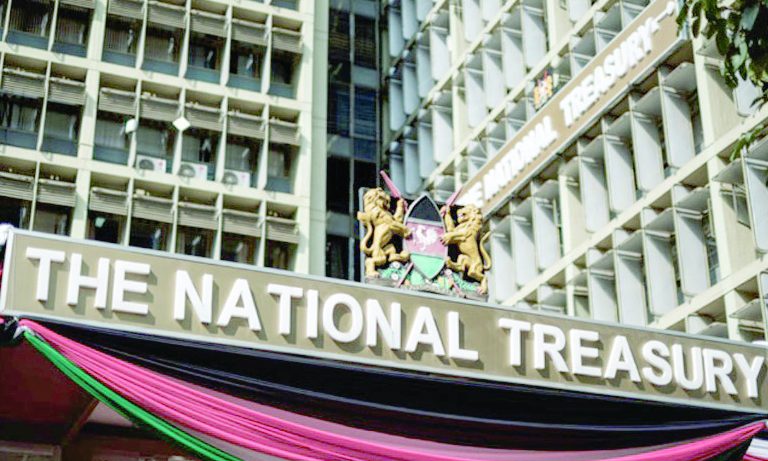
Kenya’s Treasury bills are witnessing robust demand, reflecting growing investor confidence, while the Nairobi Securities Exchange (NSE) recorded notable gains, according to the Central Bank of Kenya’s (CBK) Weekly Bulletin for August 29, 2025.
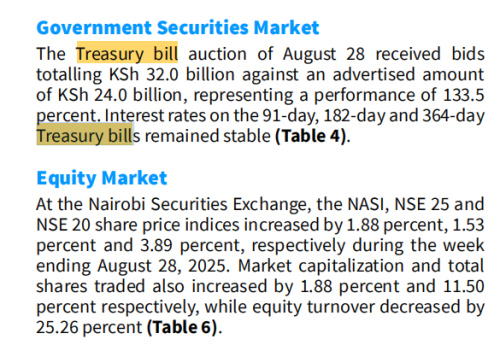
The Treasury bill auction on August 28 received bids totaling Ksh 32.0 billion against an advertised amount of Ksh 24.0 billion, achieving an oversubscription of 133.5 percent.
Interest rates remained stable across the 91-day (8.00%), 182-day (8.05%), and 364-day (9.569%) tenors, providing steady returns. Analysts attribute the surge to the CBK’s recent Central Bank Rate cut to 9.50% on August 12, making government securities increasingly attractive amid easing global economic pressures, such as Japan’s inflation rate declining to 3.1%.
“The Treasury bill auction of August 28 received bids totalling Ksh 32.0 billion against an advertised amount of Ksh 24.0 billion, representing a performance of 133.5 percent. Interest rates on the 91-day, 182-day and 364-day Treasury bills remained stable, “read part of the statement.
Equity market, investor confidence
You Might Also Like



Parallel to the Treasury bills’ performance, the NSE posted strong weekly gains. The NASI index rose by 1.88%, the NSE 25 by 1.53%, and the NSE 20 by 3.89% for the week ending August 28. Market capitalisation increased by 1.88%, while total shares traded jumped 11.50%, though equity turnover fell by 25.26%, indicating cautious profit-taking by investors.
The liquidity of the money market, supported by commercial banks’ excess reserves of Ksh 17.1 billion and an interbank rate of 9.58%, has reinforced this momentum.
Recent reforms, including single-unit share trading and single stock futures for select firms, aim to widen participation and attract younger investors, particularly targeting Kenya’s diaspora market. NSE CEO Frank Mwiti noted that these measures are part of the “Road to 9 Million Active Retail Investors” initiative, designed to boost financial inclusion and revive trading activity.
Stable currency
The Kenya Shilling remained steady at Ksh 129.24 per U.S. dollar, unchanged from the previous week, and held firm against other major and regional currencies. The CBK attributed this stability to robust foreign exchange reserves of Ksh 1,422.7 billion, sufficient for 4.8 months of import cover.
Declining Eurobond yields, easing global inflation, and steady Treasury bill returns have further reinforced investor confidence. International oil prices, which stood at USD 68.86 per barrel, translate to Ksh 8,895 per barrel, adding to cost pressures.
Domestic liquidity remains balanced, with excess reserves averaging Ksh 30.4 billion and the interbank rate at 9.47%. While global monetary tightening and rising commodity prices pose external risks, the combined strength of Treasury bill demand, equity market gains, and a stable currency signals promising prospects for Kenya’s economy, offering an attractive environment for both local and international investors.
Author
Latest News








Advertisement
More on Business