Advertisement
Stakeholders oppose proposed EAC excise duty changes in Finance Bill 2026
Tuesday 26th May, 2026 02:37 PM|

Stakeholders have urged the National Assembly’s Departmental Committee on Finance and National Planning to reconsider controversial tax proposals in the Finance Bill, 2026.
Appearing before the committee in Kiambu County on Tuesday, May 26, 2026, multinational beverage company The Coca-Cola Company and corporate law firm Anjarwalla & Khanna opposed proposals seeking to remove excise duty exemptions on goods originating from East African Community (EAC) partner states that meet the EAC Rules of Origin.
They warned that the measures could disrupt regional trade, increase production costs and hurt local manufacturing industries.
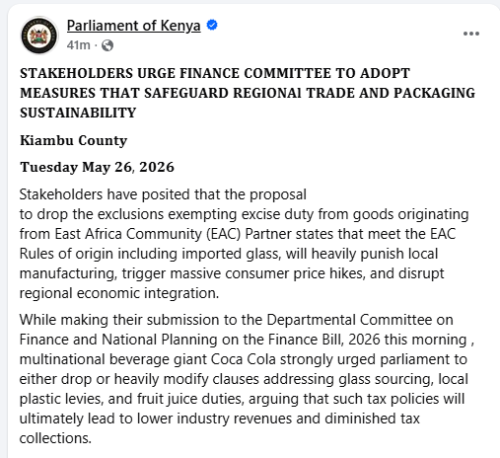
The stakeholders argued that the proposed amendments under Clause 36(a) of the Finance Bill would impose excise duty on imported glass bottles, float glass, polished glass sheets, paperboard labels and plastic sheets sourced from EAC countries, leading to sharp increases in manufacturing costs.
What Kenya lacks
You Might Also Like



They told MPs that Kenya currently lacks sufficient local glass manufacturing capacity to support the beverage industry, forcing manufacturers to depend on regional imports to sustain production.
“Local operations remain entirely insufficient to fully meet the volume, specification, and supply continuity requirements, meaning manufacturers have no near-term alternative but to rely on regional trade channels to keep production lines running,” the company submitted.
ALN Kenya warned that removing these exemptions would trigger a sharp spike in landed costs for raw materials, directly squeezing local industries.

“While the proposal may enhance domestic revenue collection, it may also discourage intra-EAC trade, disrupt established regional supply chains, and increase production costs for downstream industries that rely on competitively priced regional inputs,” the firm noted.
They further cautioned that taxing commodities such as glass bottles and sheets from neighbouring partner states threatens to undo decades of regional economic integration.
The move, they argued, directly undermines the core objectives of the EAC Treaty, the Customs Union Protocol, and the Common Market Protocol, which together champion cross-border manufacturing and the free movement of goods.
Committee response
Responding to these proposals, the Committee Members, led by the Chairperson, Kuria Kimani, presented the challenge of balancing the need to protect local industries with the requirement that Member States do not breach the EAC protocols or allow unfair business practices within Member States.

“The Challenge we have with this proposal is that we have cases of lack of reciprocity among EAC Member states. There’s a need to involve the Ministry of East African Affairs so that we are careful not to injure our relationship, while also safeguarding our local industries,” Kimani stated.
Committee Vice Chairperson Benjamin Langat sought to know whether stakeholders would support a reduced excise duty rate as a compromise.
“You say there is a glass shortage in the country. Granted, since you say 35 per cent is too high, would you be agreeable to a rate of 25 per cent?” Langat posed.
However, ALN maintained that goods originating from EAC member states should remain exempt from excise duty in line with regional agreements.
Author
Emmanuel Rono
Rono is a digital journalist with a proven track record in newsroom leadership and content creation. Currently a Digital Writer for People Daily Digital, Emmanuel’s career is rooted in a lifelong passion for storytelling. Let's talk here: [email protected] or [email protected]
View all posts by Emmanuel RonoLatest News







Advertisement
More on Business