Ruto, EAC chief hold high-level talks as Kenya pushes 50 per cent regional trade target
By Mustafa Juma, July 27, 2026President William Ruto on Monday, July 27, 2026, held high-level talks with East African Community (EAC) Secretary-General Ambassador Stephen Patrick Mbundi at State House, Nairobi, as Kenya intensified efforts to deepen regional integration and significantly increase trade among member states.
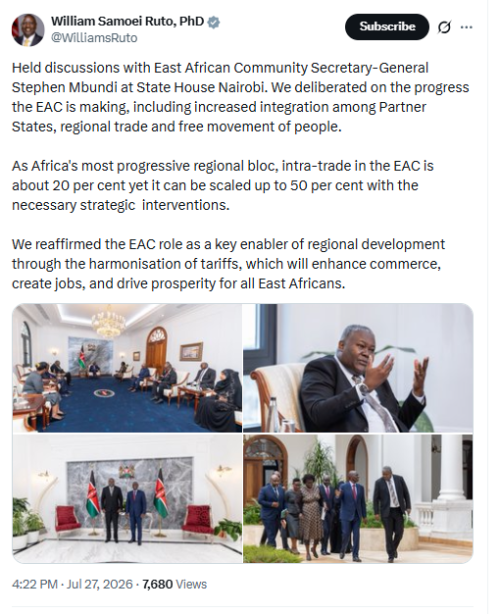
Taking to his official X account, Ruto revealed that during the meeting, they had reviewed the progress the regional bloc has made in promoting economic integration, expanding trade and facilitating the free movement of people across East Africa.
Ruto said the EAC remains Africa’s most advanced regional economic bloc but noted that trade among partner states still falls far below its full potential.
“Held discussions with East African Community Secretary-General Stephen Mbundi at State House, Nairobi. We deliberated on the progress the EAC is making, including increased integration among Partner States, regional trade and free movement of people. As Africa’s most progressive regional bloc, intra-trade in the EAC is about 20 per cent, yet it can be scaled up to 50 per cent with the necessary strategic interventions,” the President said after the meeting.
He said Kenya and the EAC Secretariat had reaffirmed the importance of harmonising tariffs and eliminating barriers to trade to unlock greater regional commerce, create jobs and accelerate economic growth.
“We reaffirmed the EAC role as a key enabler of regional development through the harmonisation of tariffs, which will enhance commerce, create jobs, and drive prosperity for all East Africans,” Ruto said.
Focus on removing trade barriers
The meeting comes just weeks after Secretary-General Mbundi called on EAC partner states to eliminate administrative bottlenecks that continue to slow cross-border trade and increase the cost of doing business across the region. He argued that removing such barriers will be essential if the Community is to achieve its ambition of raising intra-EAC trade to 50 per cent by 2030.
Earlier this month, Mbundi inspected the Sirari-Isebania and Busia One Stop Border Posts, where he urged member states to translate regional agreements into practical action by reducing delays at border crossings and improving transport corridors.
New leadership at the EAC
Monday’s discussions also mark one of the first high-level engagements between President Ruto and Mbundi since the Tanzanian diplomat assumed office as the eighth Secretary-General of the East African Community earlier this year.
Mbundi succeeded Kenya’s Veronica Nduva following his appointment by the EAC Heads of State Summit in March 2026. His appointment formed part of wider reforms within the regional bloc, including the adoption of a new financing model intended to strengthen the organisation’s financial sustainability and institutional effectiveness.
Kenya’s regional integration agenda
Kenya has consistently positioned regional integration as a key pillar of its foreign and economic policy, arguing that expanding trade within East Africa will reduce dependence on overseas markets while strengthening regional value chains.
The East African Community currently comprises Kenya, Tanzania, Uganda, Rwanda, Burundi, South Sudan, the Democratic Republic of Congo and Somalia, representing a combined market of more than 300 million people.
The bloc has implemented several integration initiatives over the years, including the Customs Union, Common Market Protocol and One Stop Border Posts aimed at easing the movement of goods and people.
Despite those milestones, businesses continue to cite non-tariff barriers, inconsistent customs procedures, infrastructure gaps and administrative delays as major obstacles to regional commerce.