Advertisement
Revealed: How remittances became Kenya’s quiet economic lifeline
Sunday 03rd May, 2026 12:59 AM|

As Kenya’s economy navigates a fragile recovery marked by moderating inflation and steady growth, an unlikely force has emerged as one of its most reliable stabilisers, not exports, not industry, but millions of Kenyans working abroad.
Diaspora remittances are quietly anchoring the economy, providing a steady stream of foreign exchange at a time when traditional export sectors face mounting pressure from global shifts, climate shocks, and structural weaknesses.
According to the latest economic outlook by LEAF Africa, remittances are projected to reach the equivalent of Ksh697 billion in 2026, reinforcing their role as a critical buffer against Kenya’s persistent trade deficit.
“Remittances have emerged as a stable external cushion, providing a reliable source of foreign exchange and helping to offset part of the persistent trade deficit,” the report notes.
You Might Also Like



Moreover, recent data from the Central Bank of Kenya (CBK) underscores this growing importance. Kenyans living and working abroad sent home Ksh58.15 billion in March 2026, the highest monthly inflow recorded this year, marking a 9.1 per cent jump from February’s Ksh53.31 billion.
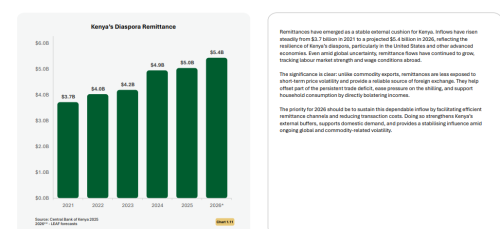
The surge pushed cumulative inflows over 12 months to Ksh655.9 billion, reflecting steady growth in what has become one of Kenya’s most dependable sources of foreign exchange.
CBK has consistently described remittances as a key source of foreign exchange earnings that continues to support the balance of payments, especially as pressure mounts on the country’s reserves.
Those reserves, while still above the statutory threshold, have been gradually declining, falling to Ksh1.718 trillion by mid-April, equivalent to 5.6 months of import cover. In this context, diaspora inflows are not just helpful; they are essential.
Outpacing traditional exports
For decades, Kenya’s export story has been built on tea and horticulture. Together, these sectors account for roughly 30 per cent of total export earnings, according to the LEAF Africa report.
Yet these traditional pillars are increasingly vulnerable to unpredictable weather, rising logistics costs, and shifting global demand.
Remittances, by contrast, are proving far more resilient.
Unlike exports tied to commodity prices or seasonal cycles, diaspora inflows are driven by labour markets abroad, particularly in North America and Europe.

Even amid global uncertainty, these flows have remained steady, reflecting the earnings and commitment of Kenyan workers overseas.
In effect, remittances are doing what exports struggle to do consistently: deliver predictable, year-round foreign exchange.
The human engine behind the numbers
Behind the billions of shillings are millions of individual stories, nurses in the United States, construction workers in the Gulf, students juggling jobs in Europe, all sending money home to support families, pay school fees, and invest in property or small businesses.
Their collective contribution has become a cornerstone of Kenya’s economic stability.
“Remittances support household consumption by directly bolstering incomes, a factor that feeds into domestic demand and cushions the economy during periods of slowdown,” the report states.
A structural gap in the economy
But the rise of remittances also exposes a deeper structural issue.
Kenya’s reliance on diaspora income reflects the country’s limited capacity to generate sufficient foreign exchange through industrial exports.
Manufacturing remains weak, contributing just over 7 per cent of GDP, while the trade deficit persists due to heavy import dependence.
This imbalance raises a critical question: why is Kenya exporting its labour more effectively than its goods?

Policy gaps, from limited industrialisation to high production costs and weak export diversification, continue to constrain the country’s ability to compete globally.
As a result, remittances have become a substitute for structural transformation rather than a complement to it.
“While remittances provide stability, they are not a silver bullet. They depend on external labour markets and migration trends, factors largely beyond Kenya’s control,” the study observes.
Even so, the report says that sustaining and maximising these inflows will require deliberate policy support, reducing transaction costs, improving remittance channels, and engaging the diaspora more strategically.
But even as policymakers look inward to fix structural weaknesses, one reality is clear.
In today’s Kenya, the most reliable export may not be tea or flowers, but its people.
Author
Latest News








Advertisement
More on Business