National Infrastructure Fund signals Kenya’s pivot from debt to investment – PS Chris Kiptoo
By Faith Lagat, December 4, 2025Treasury and Economic Planning Principal Secretary Chris Kiptoo has termed the newly established National Infrastructure Fund a turning point in Kenya’s development financing strategy, saying the country is now pivoting from debt-driven projects to sustainable investment anchored on strategic asset mobilisation.
Speaking after the signing of Project Marble, the transaction that partially divests 15 per cent of the government’s stake in Safaricom to Vodafone, PS Kiptoo underscored the significance of the move.
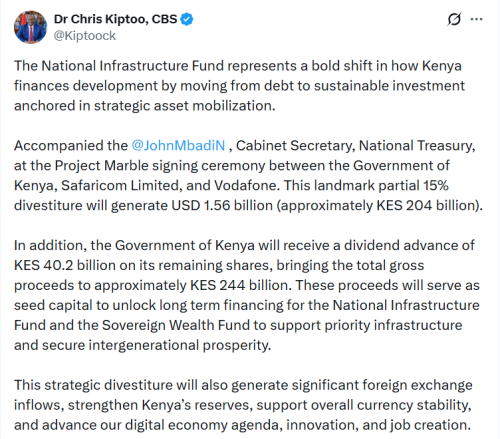
“The National Infrastructure Fund represents a bold shift in how Kenya finances development by moving from debt to sustainable investment anchored in strategic asset mobilisation,” he stated on December 4, 2025.
Govt secures Ksh244B
Kiptoo had accompanied Cabinet Secretary for the National Treasury, John Mbad,i during the signing ceremony involving the Government of Kenya, Safaricom Limited, and Vodafone. Under the agreement, Vodafone acquired a 15 per cent government stake for USD 1.56 billion, equivalent to about Ksh204 billion.
“In addition, the government of Kenya will receive a dividend advance of Ksh 40.2 billion on its remaining shares, bringing the total gross proceeds to approximately Ksh244 billion,” Kiptoo confirmed.
He noted that the entire amount will form the seed capital for two landmark financial vehicles aimed at transforming Kenya’s development landscape.
“These proceeds will serve as seed capital to unlock long-term financing for the National Infrastructure Fund and the Sovereign Wealth Fund to support priority infrastructure and secure intergenerational prosperity,” the Principal Secretary said.
Boost to foreign exchange
Kiptoo further highlighted the macroeconomic advantages of the partial divestiture, particularly its positive impact on foreign exchange flows and Kenya’s overall economic resilience.
“This strategic divestiture will also generate significant foreign exchange inflows, strengthen Kenya’s reserves, support overall currency stability, and advance our digital economy agenda, innovation, and job creation,” he added.
Despite the sale, the government maintains majority ownership of Safaricom. Officials say the move is designed to unlock fresh capital without compromising state influence in one of Kenya’s most valuable enterprises.
The National Infrastructure Fund will channel investment into priority projects, while the Sovereign Wealth Fund will safeguard revenues for long-term national prosperity.