Money market stays liquid as interbank rate edges higher -CBK
By Faith Lagat, April 18, 2026The money market remained liquid during the week ending April 16, 2026, as the Kenya Shilling Overnight Interbank Average Rate (KESONIA) edged higher to 8.76 percent on April 16 from 8.75 percent the previous week, according to the Central Bank of Kenya (CBK).
The movement occurred alongside active open market operations by the Central Bank of Kenya, aimed at aligning liquidity conditions with monetary policy objectives.
According to the CBK bulletin dated April 17, 2026, commercial banks recorded excess reserves averaging Ksh 12.8 billion above the 3.25 percent Cash Reserve Ratio requirement, reflecting continued liquidity in the banking system.
“The money market remained liquid during the week ending April 16, 2026, with open market operations remaining active. Commercial banks’ excess reserves averaged KSh 12.8 billion above the 3.25 percent Cash Reserve Ratio (CRR) requirement.”
Interbank activity moderated during the period, with the average number of transactions declining to 21 from 32 in the previous week, while the average value traded fell to Ksh 11.2 billion from Ksh 14 billion.
Despite the reduced activity, the market remained functional, with banks adjusting short-term positions efficiently to meet liquidity needs.
Exchange rate stability and reserves position
The Kenya Shilling remained stable against major global currencies during the week under review. It closed at Ksh 129.18 per US dollar on April 16, compared to Ksh 129.53 on April 9.
Stability was also recorded against the British Pound, Euro, and regional currencies including the Uganda Shilling and Tanzania Shilling, in line with daily exchange rate movements reported by the CBK.
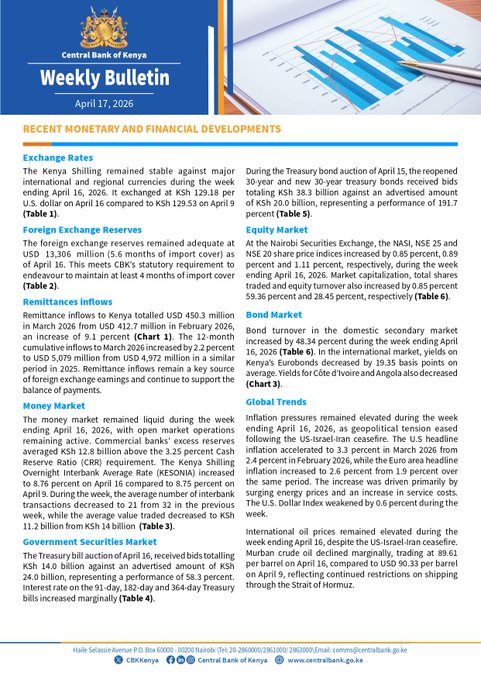
Foreign exchange reserves stood at approximately Ksh1.72 trillion, based on an exchange rate of about 129 per dollar. This level represented about 5.6 months of import cover, exceeding the statutory minimum of four months.
The reserves position continued to provide a buffer against external shocks and supported stability in the foreign exchange market.
Remittance inflows and broader monetary conditions
Remittance inflows strengthened during the period, with March 2026 inflows reaching approximately Ksh 58.09 billion,up from about Ksh 53.30 billion in February.
The 12-month cumulative inflows rose to about Ksh 655.19 billion, compared to the same period in 2025. These inflows continued to support household income flows and foreign exchange liquidity.
Treasury bill auctions recorded varied subscription levels across different maturities, reflecting shifting investor demand in government securities. The yield curve indicated market expectations across short-term and long-term instruments.
Overall liquidity conditions remained supportive of financial intermediation, with stable reserves, steady remittance inflows, and a contained interbank rate reinforcing resilience in the domestic financial system during the review period.