Mbadi unveils 4 anchors of Kenya’s investment policy
By Faith Lagat, September 4, 2025Kenya’s Cabinet Secretary for the National Treasury and Economic Planning, John Mbadi, has unveiled a new policy framework designed to propel the country into a regional investment powerhouse.
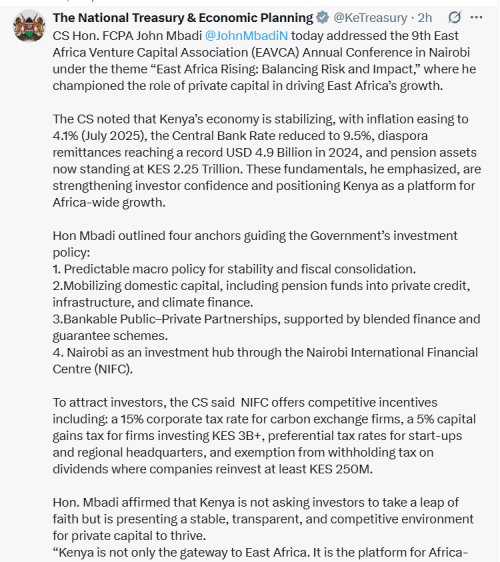
Speaking on Thursday, September 4, 2025, at the 9th East Africa Venture Capital Association (EAVCA) Annual Conference in Nairobi, Mbadi said private capital would play a decisive role in driving East Africa’s growth under the theme “East Africa Rising: Balancing Risk and Impact.”
Four anchors
In his keynote address, the CS outlined four anchors guiding the government’s investment agenda.
These include maintaining predictable macroeconomic policies to enhance stability and fiscal consolidation, mobilising domestic capital, such as pension funds, into private credit, infrastructure, and climate finance, and supporting bankable Public–Private Partnerships backed by blended finance and guarantee schemes.
The fourth anchor, he said, is strengthening Nairobi’s role as a continental investment hub through the Nairobi International Financial Centre (NIFC).
Mbadi noted that Kenya’s economy is showing signs of stabilisation, with inflation easing to 4.1 per cent in July 2025 and the Central Bank Rate reduced to 9.5 per cent. Diaspora remittances hit a record USD 4.9 billion in 2024, while pension assets have grown to Ksh2.25 trillion, boosting investor confidence.
Market resilience
Mbadi said the recent oversubscription of Treasury bills by 133.5 per cent underscored the confidence investors are placing in Kenya’s economy. At the same time, the Nairobi Securities Exchange (NSE) has posted gains, with the NASI index rising 1.88 per cent and the NSE 20 index surging 3.89 per cent in the week ending August 28.
To attract global capital, NIFC is offering incentives such as a 15 per cent corporate tax rate for carbon exchange firms, a five per cent capital gains tax for investments above Ksh 3 billion, preferential tax rates for start-ups and regional headquarters, and exemptions from dividend withholding tax for reinvestments of at least Ksh250 million.
“Kenya is not asking investors to take a leap of faith but is presenting a stable, transparent, and competitive environment for private capital to thrive,” Mbadi said.
Reforms and challenges
Beyond capital markets, the CS highlighted reforms in public procurement. The Treasury has rolled out a fully digitised e-procurement system with all state departments and counties registered, 87 per cent of corporations onboarded, and thousands of officers trained. Mbadi said the shift aims to enhance accountability and curb corruption.
However, the move has met resistance from MPs who argue the system sidelines rural suppliers due to connectivity gaps. As Parliament reconvenes, debates are expected to intensify on how to balance innovation, equity and inclusivity in shaping Kenya’s investment landscape.