Mbadi: KPC IPO is structured to balance local and foreign investment
By Faith Lagat, January 22, 2026National Treasury Cabinet Secretary John Mbadi has defended the structure of the Kenya Pipeline Company (KPC) Initial Public Offering (IPO), highlighting its design to encourage local investment while attracting regional and international capital.
In an interview with a local TV station on January 22, 2026, Mbadi explained that the IPO, which offers 65% of KPC shares to the public, aims to deepen Kenya’s capital markets and provide diverse investment opportunities without diluting government ownership.
He noted that the spread of shares provides a fair balance between local, regional, and international participation. “And I think it’s a fair spread,” he said, underscoring the government’s strategy to promote shared prosperity through KPC’s IPO.
Allocation designed for diverse investors
The CS detailed how the IPO shares are distributed. “That is why we decided that this 65%, of course, it is a traditional practice that you give the staff who have been sweating and giving their all to the company. Yes. To give 5% to the staff. 15% goes to oil marketing companies… And then now 20% we give ourselves, the Kenyans, to invest. Those who have money to put in investment. 20% we thought was appropriate. And that will be 13% of the whole company.”
Institutional investors also receive 20% of the 65%, while regional stakeholders in Uganda, Rwanda, and beyond are allocated 20% to reflect KPC’s cross-border operations. Another 20% is set aside for foreign investors to boost inflows.
IPO aims to deepen capital markets
Mbadi said the listing is intended to strengthen the Nairobi Securities Exchange (NSE) and support economic growth.
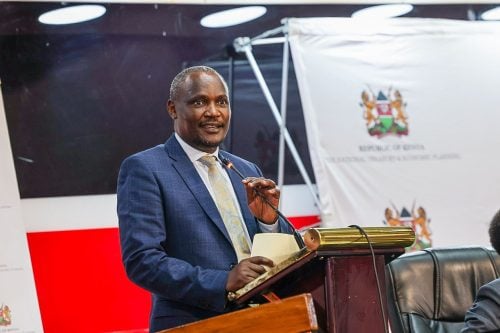
“One of the reasons why we list, or rather bring more public assets, into the Nairobi Securities Exchange is to develop the capital markets. There is a clear connection, an intrinsic correlation or connection between economic development and capital development of a country. I am sure you are aware that NSE is one of the most developed capital markets in Africa,” he said.
He emphasised the need for balance when introducing new assets.
“And when you are bringing in more assets into the market, you need to think about the local investment as you also attract foreign investment. So, we looked at the balance,” he said.
“Of course, the government of Kenya is still retaining 35%. But this 65%, we decided that a lot of it should remain within our economy for our people to invest because we want to open space, bring in another set, another option for more domestic investors.”
Promoting inclusive growth
Mbadi highlighted that the IPO is not only about raising approximately Ksh 106 billion for infrastructure but also about fostering sustainable capital market growth.
“We have many players. Our pension funds are doing very well… They need a place to invest this money and not just government paper, bonds, bills, etc. Because we are going to lower, especially with the National Infrastructure Fund, we are going to reduce our debt uptake,” he said.