Advertisement
KRA, KPA roll out major reforms to decongest Port of Mombasa
Saturday 24th January, 2026 12:25 PM|

The Kenya Revenue Authority (KRA) and Kenya Ports Authority (KPA) have unveiled wide-ranging joint reforms aimed at easing congestion at the Port of Mombasa, reducing cargo dwell time and accelerating clearance processes.
The reforms were announced on January 24, 2026, amid persistent gridlock at the port that has disrupted imports, exports and regional trade.
The measures were developed in collaboration with key stakeholders, including transporters, shippers, freight forwarders and regulators, and were unveiled during a high-level meeting chaired by KRA Commissioner-General Humphrey Wattanga and KPA Managing Director Capt. William Ruto.
Wattanga said the reforms mark a shift towards a more predictable and digitally enabled port system that supports trade facilitation and economic growth.
You Might Also Like


“The Port of Mombasa is not only a national asset but also a critical regional gateway. Our objective is to eliminate bottlenecks, reduce cargo dwell time and build a predictable, efficient and digitally enabled clearance system that supports trade and economic growth,” he said.
Capt. Ruto reaffirmed KPA’s commitment to implementing the agreed measures in partnership with KRA and industry players.
“These reforms will unlock capacity, improve operational flow and strengthen Mombasa’s competitiveness as a regional and global port. KPA will dedicate the necessary infrastructure and resources to ensure their successful implementation,” he said.
Reducing congestion
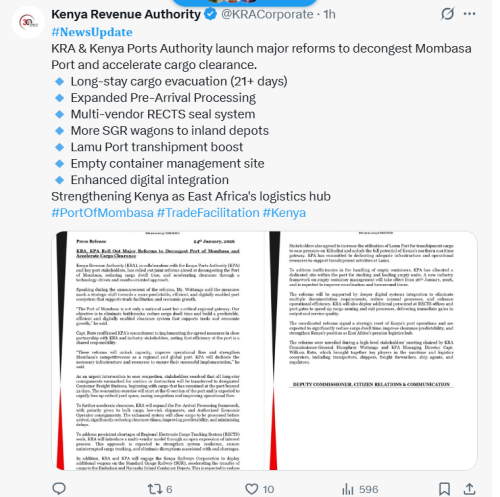
As an urgent intervention, stakeholders agreed that all long-stay consignments earmarked for auction or destruction will be transferred to designated Container Freight Stations once they exceed 21 days at the port. The evacuation exercise will prioritise cargo in the G-section and is expected to free up critical yard space, easing congestion and improving operational flow.
To further speed up clearance, KRA will expand its Pre-Arrival Processing framework, with priority given to bulk cargo, low-risk shipments and Authorised Economic Operator consignments. Under the enhanced system, cargo will be processed before arrival, significantly reducing clearance times, improving predictability and minimising delays.
Strengthening tracking and cargo evacuation
To address persistent shortages of Regional Electronic Cargo Tracking System (RECTS) seals, KRA will introduce a multi-vendor model through an open expression of interest process.
The move is expected to strengthen system resilience, ensure uninterrupted cargo tracking and eliminate disruptions linked to seal shortages.
KRA and KPA will also engage the Kenya Railways Corporation to deploy additional wagons on the Standard Gauge Railway to speed up the transfer of cargo to the Embakasi and Naivasha Inland Container Depots.
his is expected to reduce pressure on the port and key road corridors while improving evacuation timelines.
Expanding capacity and digital integration
Stakeholders further agreed to increase the utilisation of Lamu Port for transhipment cargo to ease pressure on Kilindini Harbour. KPA has committed to providing adequate infrastructure and operational resources to support transhipment activities at Lamu.
To improve the handling of empty containers, KPA has allocated a dedicated site within the port for stacking and loading empty units. A new industry framework on empty container management will take effect from January 26, 2026, and is expected to enhance coordination and turnaround times.
The reforms will be supported by deeper digital systems integration to eliminate multiple documentation requirements, reduce manual processes and improve efficiency. KRA will also deploy additional personnel at RECTS offices and port gates to speed up cargo arming and exit processes.
The coordinated measures are expected to significantly reduce cargo dwell time, improve clearance predictability and strengthen Kenya’s position as East Africa’s leading logistics hub.
Author
Latest News






Advertisement
More on Business