KNBS launches first-ever Kenya Household Remittances Survey report
By Sharon Atieno, June 16, 2026The Kenya National Bureau of Statistics (KNBS) has launched the 2025 Remittance Household Survey Report, marking the first-ever national study designed to comprehensively measure household remittance flows in Kenya.
Speaking during a presentation on the launch of the report on Tuesday, June 16, 2026, KNBS Director of Economic Statistics Benjamin Muchiri, who said the survey provides critical evidence on both formal and informal money transfers in and out of Kenyan households.
“Remittance is not just a monetary payment. It can also be goods received for free, or transfers sent abroad to relatives without expecting anything in return. It is a broad concept that captures both cash and in-kind flows across households,” he said.
Muchiri further noted that the survey fills critical data gaps in understanding how households send, receive and utilize remittances across the country.
“This was the first-ever household remittances survey in Kenya conducted to address data gaps in household remittance flows,” he added.
Objectives of the survey
The survey was designed to establish the magnitude of remittance flows into (inflows) and out (outflows) of Kenya, covering both cash and in-kind transfers. It also sought to capture the scale of informal remittances that are not recorded under the International Transactions Reporting System (ITRS), and to provide a clearer picture of money flows that often fall outside formal tracking systems.
In addition, the study aimed to measure remittances based on geographical sources and destinations, showing where funds originate and where they are sent. It further examined the channels used for sending remittances, including the costs associated with different transfer methods.
The survey also focused on how households utilise remittances, providing insight into their role in supporting livelihoods, consumption, and economic activity. Finally, it sought to generate policy recommendations aimed at improving the overall remittance landscape, including efficiency, accessibility, and regulatory frameworks.
Survey captures formal and informal flows
The study focused on both inward and outward remittances through all channels, including informal transfers that are often excluded from official data systems.
KNBS confirmed that this is the inaugural nationwide household remittance survey, undertaken in collaboration with Financial Sector Deepening Kenya (FSD) ,CBK and GAP.
Survey design and methodology
On methodology, KNBS said the Remittance Household Survey (RHS) used a cross-sectional survey design and adopted a two-stage stratified cluster sampling approach. In the first stage, enumeration areas were randomly selected, while in the second stage households were randomly selected for participation.
The sampling frame was drawn from the list of enumeration areas used in the 2019 Kenya Population and Housing Census (KPHC), which was further stratified by region and concentration of emigrants to ensure representation across different population groups.
The survey targeted 4,440 households drawn from 444 enumeration areas. Household listing was first conducted to identify eligible households, particularly those receiving or sending remittances.
The reference period for the study covered 12 months, from June 2024 to May 2025, while data collection was carried out over a 30-day period in August 2025.
Rural households dominate remittance activity
Findings show that rural households account for the majority of remittance-related activity across categories.
Households receiving remittance inflows stood at 679,852, with 65.1 per cent in rural areas compared to 34.9 per cent in urban areas.
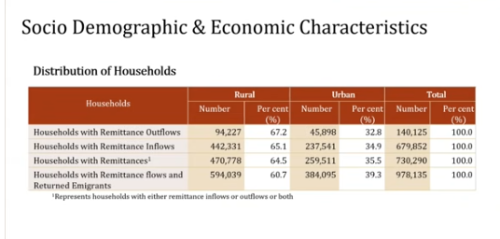
Those with remittance outflows were recorded at 140,125 households, with 67.2 per cent in rural areas.
Overall, households engaged in any remittance flows totalled 730,290, while those with both remittance flows and returned emigrants reached 978,135.
The report is expected to inform future economic planning and improve understanding of how remittances support household welfare and national development.