KNBS Consumer Index: Why Kenyans still feel the cost of living despite falling electricity bills
By Aloys Michael, July 3, 2026For many Kenyan households, opening a monthly electricity bill has become synonymous with anxiety. Yet the latest government data presents an unexpected twist: electricity prices have actually fallen over the past year, even as millions of families continue to grapple with an escalating cost of living.
According to the Kenya National Bureau of Statistics (KNBS) Consumer Price Indices and Inflation Report for June 2026, the average price of electricity declined in both the short and long term, bucking the widespread perception that power costs are driving household financial strain.
The report shows that the average cost of consuming 50 kilowatt-hours (kWh) of electricity fell by 1.2 per cent between May and June 2026, while the average cost for 200 kWh declined by 1.1 per cent over the same period. On an annual basis, the price of 50 kWh was 2.9 per cent lower than in June 2025, while 200 kWh dropped 4.6 per cent year-on-year.
“The average price of 50 kWh of electricity declined by 1.2 per cent between May 2026 and June 2026. Similarly, the average price of 200 kWh of electricity decreased by 1.1 per cent over the same period,” KNBS said in the report.
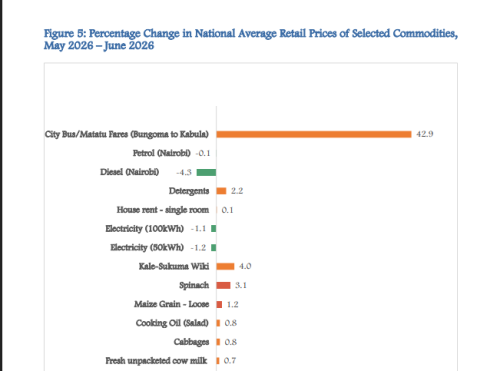
Further data indicates the average price for 200 kWh dropped from Ksh5,535.22 in May to Ksh5,476.34 in June, while the cost of 50 kWh fell from Ksh1,258.57 to Ksh1,243.85.
Despite these reductions, few households are likely to feel any meaningful financial relief.
The reason lies in the broader picture painted by the same report. Kenya’s annual inflation accelerated to 6.4 per cent in June 2026, with sharp increases in food prices and transport costs continuing to squeeze household budgets.
“Inflation was primarily driven by a rise in prices of items in the Food and Non-Alcoholic Beverages (8.6%), Transport (16.1%), and Housing, Water, Electricity, Gas and Other Fuels (3.4%)”, KNBS notes, adding that the three categories account for more than 57 per cent of total household expenditure.
While electricity charges have eased, the broader Housing, Water, Electricity, Gas and Other Fuels category still recorded annual inflation of 3.4 per cent, reflecting increases in other unavoidable household expenses.
For many families, rent remains one of the biggest pressures. KNBS data shows the average monthly rent for a single room increased from Ksh4,212.89 in May to Ksh4,218.03 in June, continuing a gradual upward trend.
Meanwhile, savings on electricity are easily overshadowed by persistent increases in food prices.
Although tomatoes and beans became slightly cheaper during the month, staples such as maize grain, cooking oil, cabbage, spinach, sukuma wiki and fresh milk all registered price increases. Sukuma wiki prices alone rose 4 per cent in one month and were 26.6 per cent higher than a year earlier.
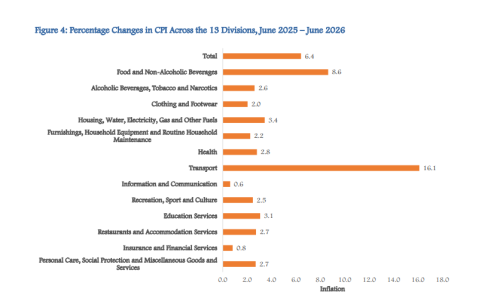
Transport costs are exerting an even greater influence on household spending. KNBS reports that the transport division recorded the highest annual inflation among all expenditure categories at 16.1 per cent, despite a decline in fuel prices during June. Diesel prices in Nairobi fell from Ksh232.86 to Ksh222.86 per litre, while petrol edged down slightly from Ksh214.25 to Ksh214.03.
The bureau noted that diesel recorded the largest monthly decline, falling by 6.3 per cent, while petrol prices decreased marginally.
The contrast highlights a growing disconnect between falling prices for some regulated utilities and the everyday expenses that households cannot easily avoid.
Electricity tariffs are only one component of household expenditure, and lower power costs alone cannot offset rising food, transport and housing expenses. Families experience inflation through their total monthly spending rather than a single bill.
In other words, lower electricity bills may offer modest relief, but they are being drowned out by the much louder pressures of inflation elsewhere in the household budget.