Kenyan millionaires buying farms for food security and carbon credits – report
By Faith Lagat, July 15, 2026Kenyan High-Net-Worth Individuals (HNWIs) are increasingly investing in farmland, driven by food production, environmental sustainability and new income opportunities from carbon credits, according to Knight Frank’s Wealth & Investment Trends 2026 report.
The report identifies farmland as one of the leading investment sectors for affluent Kenyans in 2026, alongside data centres, the residential private rented sector and hotels.
According to the survey, 29 per cent of wealth managers ranked farmland among the top investment priorities for their clients, reflecting growing confidence in agricultural land as a long-term asset.
Food security drives investment
Food production remains the primary reason Kenyan millionaires are acquiring farmland.
The report shows that all respondents indicated their clients prioritise food production when investing in agricultural land. This represents an increase from 2025, when 83 per cent cited food production as the main motivation.
“This strong preference underscores the central role of agriculture in Kenya’s economy and growing concerns about food security and self-sufficiency,” the report states.
Knight Frank notes that continued population growth and rising demand for agricultural commodities are reinforcing farmland’s appeal as both an investment and a strategic response to long-term food supply challenges.
The report indicates that investors increasingly view farmland as an asset capable of delivering stable returns while contributing to national food security objectives.
Carbon credits gain traction
Beyond agricultural production, wealthy investors are also targeting sustainability-related opportunities linked to farmland.
According to the report, 63 per cent of respondents cited tree planting and afforestation as important investment considerations, while 50 per cent identified carbon credits as a key source of potential income.
A further 44 per cent pointed to broader environmental and sustainability benefits associated with agricultural land.
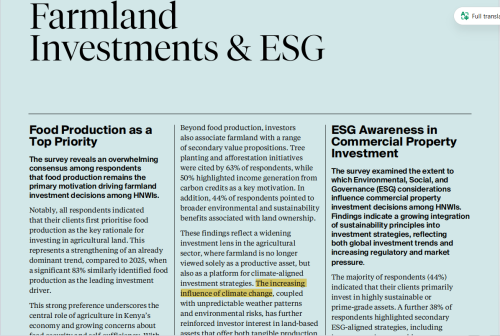
“Farmland is no longer viewed solely as a productive asset, but also as a platform for climate-aligned investment strategies,” the report notes.
“The increasing influence of climate change, coupled with unpredictable weather patterns and environmental risks, has further reinforced investor interest in land-based assets that offer both tangible production value and emerging sustainability-linked revenue streams.”
The findings suggest investors are increasingly integrating environmental considerations into their long-term wealth preservation strategies.
Shift towards resilient assets
The report says the growing interest in farmland reflects a broader shift among Kenyan HNWIs towards real assets that generate income while preserving wealth over the long term.
Knight Frank notes that investors are moving away from concentrating wealth in primary and secondary homes and are increasingly seeking resilient, income-generating investments aligned with environmental, social and governance (ESG) principles.
Farmland offers several advantages, including limited supply, long-term capital appreciation and opportunities to generate returns through agricultural production and carbon markets.
The report also highlights rising interest in renewable energy-enabled investments, green-certified developments and projects that combine financial returns with sustainability objectives.
While affluent Kenyans continue to invest in passion assets such as art and luxury watches, the report indicates that a growing share of capital is being directed towards productive assets that support both economic resilience and environmental sustainability.
Knight Frank concludes that Kenyan HNWIs are increasingly balancing wealth preservation with investments that respond to evolving climate, food security and sustainability priorities.