Advertisement
Kenyan families spend diaspora money mostly on food, education and hospital bills – KNBS
Wednesday 17th June, 2026 07:53 AM|
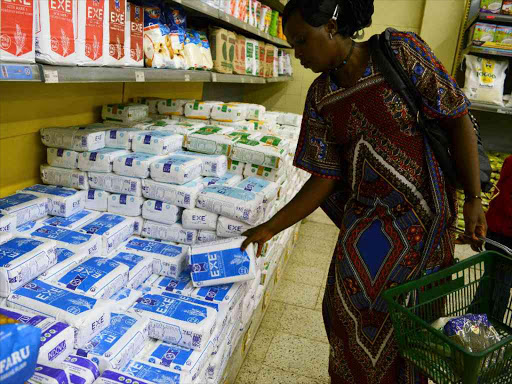
Kenyan households are using the bulk of money sent home by relatives abroad to meet basic needs such as food, education and healthcare, revealing the critical role diaspora remittances play in supporting family livelihoods amid rising living costs.
According to the Kenya National Bureau of Statistics (KNBS) 2025 Remittances Household Survey released on Tuesday, June 16, 2026, households received an estimated Ksh931.8 billion in remittances between June 2024 and May 2025, making diaspora cash one of the country’s most important sources of household income.
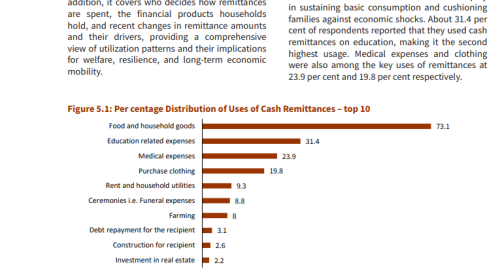
The survey shows that 73.1 per cent of remittance recipients used the funds to purchase food and household goods, making it the single largest expenditure category among Kenyan families receiving money from abroad.
“Food and household goods accounted for the highest proportion of expenditure among households receiving remittances,” the report states.
You Might Also Like



Education emerged as the second-largest use of remittances, with 31.4 per cent of recipient households directing the funds towards school fees and other learning-related expenses.
The findings suggest that diaspora earnings have become a crucial source of financing for education, particularly at a time when many families continue to grapple with high tuition costs and increased household financial pressures.
Healthcare was the third most common use of remittances, with 23.9 per cent of households spending the money on medical expenses.
The data points to the growing burden of healthcare costs and the reliance on relatives abroad to help families access treatment and essential medical services.
The KNBS survey reveals that remittances act more as a social safety net than a source of investment capital. While substantial sums are flowing into the country, most households are using the funds to cover consumption and welfare needs rather than building long-term assets.
This trend is reflected in the survey’s investment data. Only 2.2 per cent of recipient households reported using remittances for real estate investments, despite property traditionally being viewed as one of the most popular investment channels among Kenyans.
The findings suggest that economic realities are forcing many households to prioritise immediate needs over wealth creation.

The report notes that remittances remain a key pillar of household survival, with more than one in five recipient households identifying them as their main source of livelihood. This highlights the growing importance of diaspora earnings in cushioning families from economic shocks, unemployment and fluctuating incomes.
The dominance of spending on food also mirrors broader economic trends in Kenya, where inflationary pressures and rising prices of basic commodities have strained household budgets in recent years.
The survey further indicates that remittances support human capital development through education spending, helping families keep children in school and meet the rising costs associated with learning.
While policymakers often encourage the productive investment of remittances into businesses and asset creation, the report suggests that many households may lack the financial flexibility to invest when faced with pressing daily expenses.
Kenya continues to rank among Africa’s leading recipients of diaspora remittances, with the United States remaining the largest source of inflows.
The survey found that the US accounted for 43.5 per cent of all remittances received by Kenyan households.
Author
Latest News






Advertisement
More on Business