Kenya, IMF reaffirm partnership on economic reforms
By Faith Lagat, May 19, 2026Kenya and the International Monetary Fund (IMF) have reaffirmed their partnership on economic reforms as global financial leaders respond to rising uncertainty linked to the ongoing Iran conflict and broader pressures on the global economy.
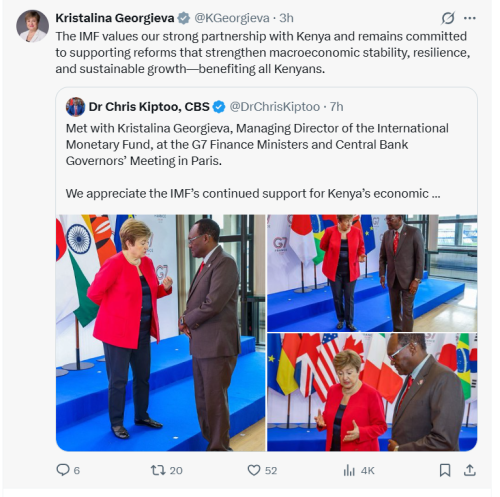
Principal Secretary to the National Treasury Chris Kiptoo met IMF Managing Director Kristalina Georgieva on the sidelines of the G7 Finance Ministers’ and Central Bank Governors’ Meeting in Paris on Tuesday, May 19, 2026.
The discussions focused on Kenya’s ongoing fiscal reforms and efforts to maintain economic stability amid rising global risks.
Strengthening Kenya-IMF cooperation
During the meeting, Kiptoo expressed appreciation for the IMF’s continued support for Kenya’s economic reform programme, which aims to address fiscal pressures while supporting long-term growth.
Georgieva reaffirmed the IMF’s commitment to working closely with Kenya, stating: “The IMF values our strong partnership with Kenya and remains committed to supporting reforms that strengthen macroeconomic stability, resilience, and sustainable growth, benefiting all Kenyans.”
The Paris meeting, hosted under France’s G7 Presidency, brought together finance ministers and central bank governors from major advanced economies alongside partners including Kenya, Brazil, India, and South Korea. International institutions such as the IMF, World Bank, and OECD also participated in the discussions.
Leaders at the meeting raised concerns over disruptions to energy, food, and fertiliser supply chains caused by instability in the Middle East, particularly around the Strait of Hormuz.
The G7 communiqué warned of “multiple and complex global challenges” and called for coordinated responses to protect vulnerable economies from inflation, supply shortages, and slower growth.
Fuel crisis and domestic economic pressure
The renewed engagement with the IMF comes at a time when Kenya is facing mounting economic pressure linked to rising global fuel prices. Recent increases in fuel costs triggered nationwide protests and transport disruptions, with matatu operators and other transport stakeholders demanding further government intervention.
In response, the Energy and Petroleum Regulatory Authority adjusted pump prices by lowering diesel prices while increasing kerosene prices to curb adulteration. However, many transport operators argued that the relief measures were insufficient given the continued rise in operating costs.
Treasury officials view the planned IMF programme as critical in helping Kenya navigate external shocks while maintaining fiscal stability. Treasury Cabinet Secretary John Mbadi recently indicated that discussions on a new IMF arrangement could be concluded in June or July.
Focus on long-term resilience
Kenya’s public debt currently stands at approximately Ksh12.4 trillion, while the 2026/27 budget projects a deficit of Ksh1.14 trillion. Government officials say the new IMF arrangement is expected to focus on policy support and economic reforms aimed at strengthening resilience rather than direct budget financing.
The IMF has also warned that economic growth in Sub-Saharan Africa is expected to slow slightly due to global instability and commodity market pressures. Kenya’s participation in high-level international forums reflects its efforts to strengthen partnerships, attract investor confidence, and position itself within ongoing global economic discussions.