Advertisement
Kenya adopts satellite-based earth observation technology to boost food security
Tuesday 05th May, 2026 07:39 PM|

Kenya has launched a new initiative aimed at harnessing satellite-based earth observation technologies to strengthen irrigation planning and improve food security amid recurring droughts and climate variability.
Principal Secretary for Irrigation Ephantus Kimotho on Tuesday opened the three-day Earth Observation for Irrigation Mapping workshop in Nairobi, running from May 5 to May 7, 2026.
The workshop, under the IrrEO Project, is being implemented by the Regional Centre for Mapping of Resources for Development in collaboration with the University of Manchester.
It brings together officials from the State Departments of Irrigation and Agriculture, the National Irrigation Authority, county governments, and regional partners from Ethiopia and Nigeria. The programme seeks to co-design Earth Observation tools suited to Kenya’s context, identify existing data gaps, and support evidence-based investment and policy planning.
Earth Observation adoption
You Might Also Like


During the opening ceremony, PS Kimotho highlighted the role of Earth Observation technologies in improving real-time data collection, resource planning, and irrigation management.
He said the initiative would examine opportunities and barriers to adoption while enhancing collaboration among national and county institutions.
“This initiative will assess opportunities and barriers to EO adoption while fostering collaboration across national and county institutions,” he said.
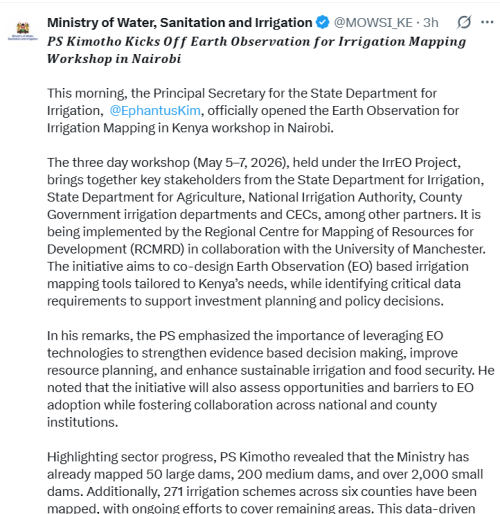
He noted that ongoing mapping efforts had documented 50 large dams, 200 medium dams, more than 2,000 small dams, and 271 irrigation schemes across six counties, with nationwide mapping still underway.
Irrigation expansion targets and flagship projects
Kenya aims to expand irrigated land from its current 762,000 acres to 1.7 million acres, with an additional target of one million acres under broader irrigation development plans. The National Irrigation Sector Investment Plan (NISIP) is guiding flagship interventions intended to address rice production gaps and strengthen food security.
Efforts also continue to unlock the full 200,000-acre potential of the Galana Irrigation Scheme through improvements in water infrastructure and distribution systems.
Regional irrigation push and financing outlook
Kenya’s initiative aligns with broader African efforts to scale irrigation to address food shortages linked to erratic rainfall and population growth.
A World Bank report titled Nourish and Flourish: Water Solutions to Feed 10 Billion People on a Livable Planet, released in March 2026, states that current agricultural systems can sustainably feed about 3.4 billion people, below the projected global population of 10 billion by 2050.
The report estimates irrigation expansion could generate 245 million jobs globally, including 218 million in Sub-Saharan Africa. It also cautions that large-scale irrigation projects may increase debt exposure if implementation delays persist, with risks including cost overruns, unequal benefits distribution, environmental pressures from over-extraction, and potential water use conflicts. The report notes that some countries continue to rely on food imports despite investment in irrigation infrastructure.
It highlights decentralised approaches such as solar-powered pumps and drip irrigation as complementary options, alongside results-based financing mechanisms supported by development partners, including the Gates Foundation.
Kenya’s Earth Observation mapping initiative is part of ongoing efforts to improve planning and investment decisions in the irrigation sector. The three-day workshop is expected to conclude with recommendations on integrating Earth Observation tools into national and county irrigation planning and investment decision-making frameworks in Kenya.
Author
Latest News






Advertisement
More on Business