Irungu Nyakera slams govt’s Safaricom stake sale
By Joel Masibo, December 5, 2025The Democracy for the Citizens Party (DCP), Nairobi Patron Irungu Nyakera, has criticised the Kenyan government’s decision to offload a 15 per cent stake in Safaricom to Vodacom.
Nyakera has broken his silence after the move taken by the state has ignited intense public debate, balancing optimism about a major financial windfall against concerns over long-term national interests.
The deal and proceeds
The particular deal is priced at Ksh34 per share, about a 20 per cent premium on the market rate. The sale is expected to raise approximately Ksh244–245 billion for the State, including an advance dividend payment. Once completed, Vodacom’s effective control of Safaricom will rise to around 55 per cent, while government ownership will drop from 35 per cent to roughly 20 per cent.
While the transaction itself is commercially sound, it is the use of the proceeds that has triggered serious concern among economic analysts and policy observers. Nyakera, former Principal Secretary, has been one of the most vocal voices urging caution.
He argues that although the sale is neither strange nor rushed, given that the buyer already holds a controlling stake, the crucial test lies in whether the government channels the money into productive, long-term investments.
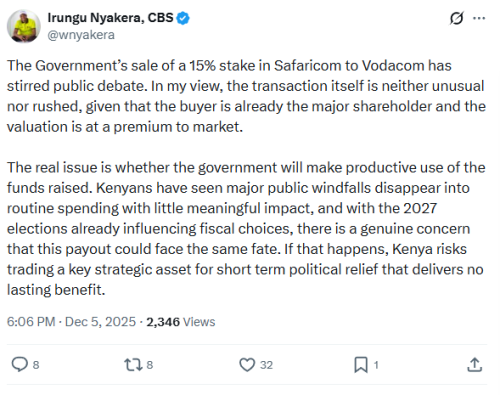
”The Government’s sale of a 15 per cent stake in Safaricom to Vodacom has stirred public debate. In my view, the transaction itself is neither unusual nor rushed, given that the buyer is already the major shareholder and the valuation is at a premium to market,” Nyakera took to X on Friday, December 5, 2025.
Kenya’s history with large public windfalls casts a long shadow over the debate. Nyakera notes that past payouts have often disappeared into recurrent expenditure, leaving little tangible developmental impact. With the 2027 elections already shaping fiscal decisions, many fear that political pressures could divert the funds toward short-term spending rather than structural transformation.
”The real issue is whether the government will make productive use of the funds raised. Kenyans have seen major public windfalls disappear into routine spending with little meaningful impact, and with the 2027 elections already influencing fiscal choices, there is a genuine concern that this payout could face the same fate. If that happens, Kenya risks trading a key strategic asset for short-term political relief that delivers no lasting benefit,” he added.
What the deal involves
Premium sale price: Vodacom agreed to pay Ksh34 per share for the 15 per cent block, a clear premium over the trading price, offering the State a favourable deal.
Total proceeds: The government is set to receive about Ksh204.3 billion from the share sale plus an additional Ksh40.2 billion in advance dividends, totalling roughly Ksh244–245 billion.
Change in control: The move strengthens Vodacom/Vodafone’s grip on Safaricom to around 55 per cent, while Kenya’s ownership shrinks to 20 per cent, raising questions about future influence over a strategic telecom asset.
Why proponents support the sale
A competitive price and ready buyer
Selling at a 20 per cent premium makes the transaction financially compelling and reduces accusations of undervaluing a prized national asset.
A non-debt way to raise infrastructure capital

The State has been under pressure to fund major infrastructure projects without ballooning public debt. Redirecting proceeds into a national infrastructure fund, as government officials have suggested, offers a potentially responsible funding alternative.
Strengthening Safaricom’s investment capacity
A private majority shareholder with deep telecom experience may accelerate Safaricom’s technological growth, regional integration, and investments, ultimately benefiting consumers and the broader economy.