Inside EAC’s renewed push for a single currency by 2031
By Faith Lagat, July 26, 2026East African central bank governors have renewed their push to establish a single regional currency by 2031, agreeing to accelerate reforms needed to advance the East African Monetary Union (EAMU) despite uneven progress across Partner States.
The commitment was made during the 29th Ordinary Meeting of the East African Community (EAC) Monetary Affairs Committee (MAC) held in Kampala, Uganda, on July 24, 2026.
The meeting was chaired by Bank of Uganda Governor Michael Atingi-Ego and brought together governors and senior officials from the central banks of Kenya, Tanzania, Somalia, Burundi, South Sudan and Rwanda, alongside representatives from the EAC Secretariat.
“The meeting was held against a backdrop of heightened global risks attributed to high international oil prices and shipping costs linked to the conflict in the Middle East,” the CBK X post read in part.
Regional growth remains resilient
The meeting took place amid heightened global economic uncertainty driven by rising international oil prices and shipping costs linked to the conflict in the Middle East.
According to the committee, global economic growth is projected to slow to 3.0 per cent in 2026 from 3.5 per cent in 2025, while inflation is expected to rise because of higher energy prices.
Despite those challenges, governors said the East African region is expected to maintain strong economic performance. Growth across the EAC is projected at 5.2 per cent in 2026, remaining above the Sub-Saharan Africa average of 4.3 per cent.
Average headline inflation across the region eased to 6.7 per cent in the 2025/26 fiscal year from 9.6 per cent in 2024/25. The committee said inflation is expected to remain moderate if tensions in the Middle East ease gradually.
Regional currencies are also expected to remain broadly stable, supported by diversified foreign exchange inflows and reforms aimed at strengthening domestic foreign exchange markets.
Roadmap to monetary union
A key agenda item was the review of progress made in implementing the revised roadmap toward the East African Monetary Union and the planned introduction of a single regional currency by 2031.
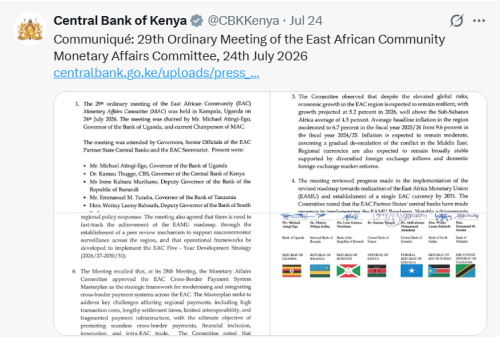
The committee noted progress in modernising and harmonising monetary policy frameworks, strengthening data compilation and risk management systems, enhancing policy coordination through joint research, promoting the East African Payment System and investing in capacity building across central banks.
Even with those gains, governors observed that progress remains uneven. None of the EAC Partner States has met all four primary macroeconomic convergence criteria required before the monetary union can be realised.
The committee said the region continues to face the challenge of maintaining macroeconomic stability while financing major infrastructure projects amid a volatile global environment.
Governors agreed that Partner States should strengthen economic resilience by diversifying international reserves through domestic gold purchases, attracting remittance inflows and coordinating regional policy responses.
They also backed the establishment of a peer review mechanism to strengthen macroeconomic surveillance and called for operational frameworks to implement the EAC Five-Year Development Strategy for 2026/27 to 2030/31.
Payments, cybersecurity in focus
The committee also reviewed progress in implementing the EAC Cross-Border Payment System Masterplan, which was approved during its previous meeting.
The masterplan seeks to reduce transaction costs, shorten settlement times, improve interoperability and modernise regional payment infrastructure to support financial inclusion and boost intra-EAC trade.
Governors noted that implementation has begun, with annual work plans prepared, priority initiatives identified and financial and technical resources mobilised.
The committee further observed that the region’s financial sector remains stable and resilient, supported by adequate capital and liquidity buffers. However, it identified cybersecurity as an emerging threat to financial stability and agreed to strengthen regional cooperation and introduce measures to address the growing risks.
The meeting concluded with governors thanking the Bank of Uganda for hosting the session and reaffirming their commitment to advancing regional monetary integration and delivering the East African Monetary Union roadmap.