How Vodacom bought rights to future Safaricom dividends
By Kenneth Mwenda, July 27, 2026Vodacom has revealed fresh details of one of the least understood parts of its acquisition of a controlling stake in Safaricom, showing it paid Ksh40.2 billion for rights to receive part of the Kenyan government’s future dividends from the telecommunications giant.
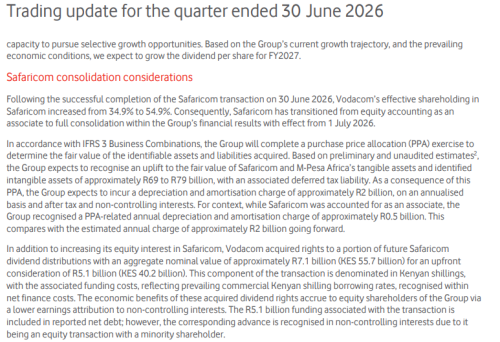
The South African telecommunications company disclosed in its trading update for the quarter ended June 30, 2026, that the dividend rights have a total nominal value of about Ksh55.7 billion, meaning Vodacom stands to receive substantially more than the amount it paid upfront if the expected dividends are fully distributed.
The arrangement forms part of the wider transaction that increased Vodacom’s effective stake in Safaricom from 34.9 per cent to 54.9 per cent, giving it majority control of Kenya’s largest telecommunications company from July 1, 2026.
Unlike the share purchase itself, the dividend agreement does not involve buying additional Safaricom shares. Instead, Vodacom paid Ksh40.2 billion in exchange for the right to receive a portion of future dividend payments that would otherwise have gone to the Kenyan government.
According to the company, the dividend rights carry an aggregate nominal value of approximately Ksh55.7 billion, suggesting the future distributions exceed the upfront amount paid by about Ksh15.5 billion before financing costs and other expenses are taken into account.
Vodacom said the dividend arrangement is denominated entirely in Kenyan shillings. The company financed the payment using Kenyan shilling borrowings at prevailing commercial lending rates, with the interest costs recognised under net finance costs.
“The economic benefits of these acquired dividend rights accrue to equity shareholders of the Group via a lower earnings attribution to non-controlling interests,” Vodacom said in its quarterly trading update.
In simple terms, that means more of Safaricom’s future profits will ultimately be attributable to Vodacom shareholders rather than minority investors.
Safaricom fully joins Vodacom
The company also explained that while the Ksh40.2 billion funding increases its reported net debt, the corresponding advance is recognised under non-controlling interests because the arrangement is treated as an equity transaction with a minority shareholder rather than a conventional acquisition.
The dividend rights agreement sits alongside the broader takeover that transformed Safaricom from an associate company into a fully consolidated subsidiary within Vodacom’s financial statements from July 1.
That accounting change means Vodacom will now report Safaricom’s revenues, assets, liabilities and profits directly in its consolidated accounts instead of recognising only its share of earnings.
Under International Financial Reporting Standard (IFRS) 3, Vodacom will carry out a purchase price allocation exercise to establish the fair value of the acquired assets and liabilities.
The company expects that exercise to increase the value of Safaricom and M-Pesa Africa’s tangible and identifiable intangible assets by between R69 billion (about Ksh542 billion) and R79 billion (about Ksh621 billion). The higher valuation will also increase annual depreciation and amortisation charges from about R500 million (roughly Ksh3.9 billion) previously to around R2 billion (about Ksh15.7 billion) a year.
Vodacom Group Chief Executive Shameel Joosub described the acquisition as a major milestone for the business.
“This strategically important transaction represents a major milestone in our Vision 2030 journey, significantly enhancing the Group’s scale, diversification and long-term growth prospects.”
The acquisition has already prompted Vodacom to upgrade its medium-term growth outlook, with financial services expected to contribute more than 22 per cent of Group service revenue after Safaricom’s consolidation, up from about 13 per cent previously.